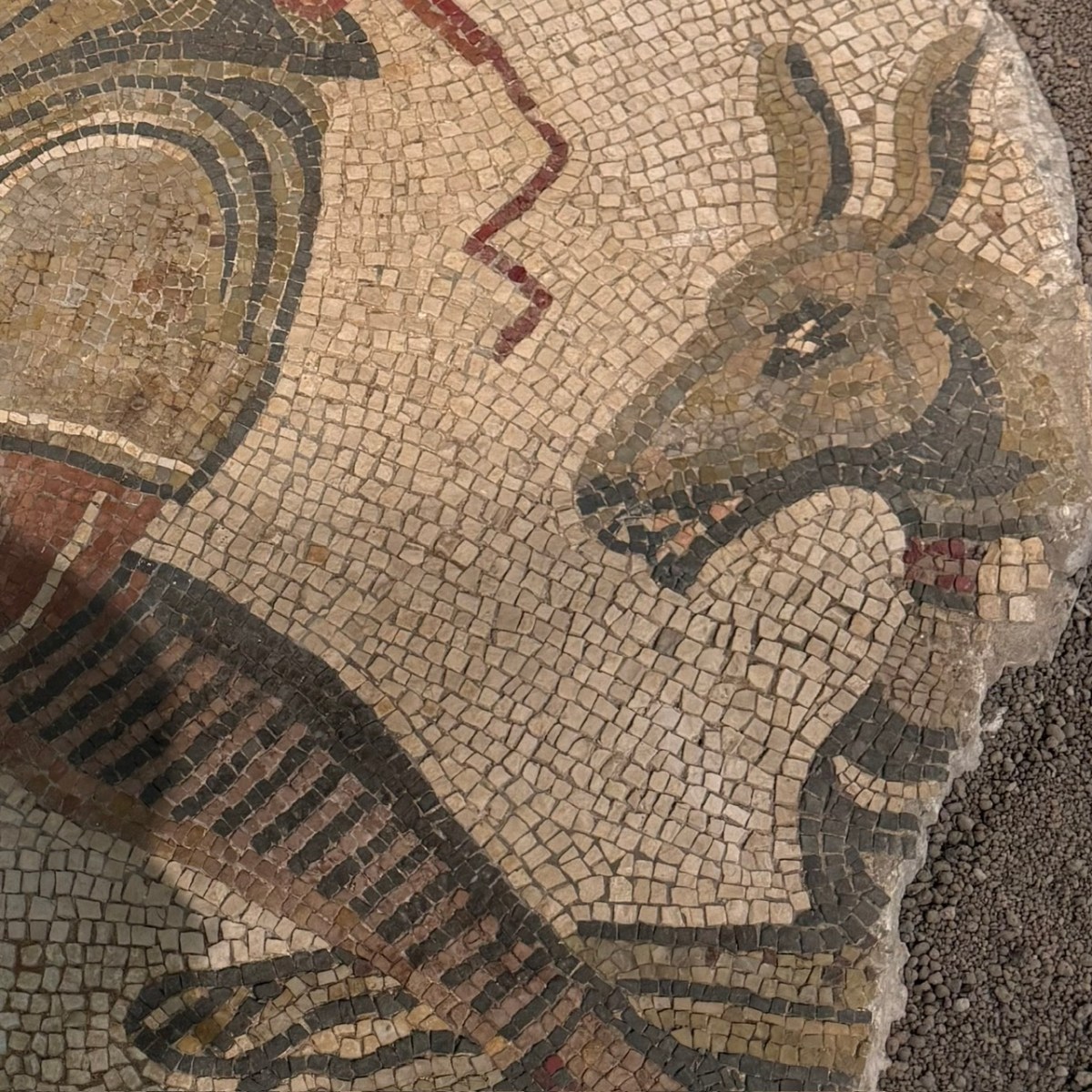
We often use animal terms to describe humans: bitch, dog-eyed, lap-dog, watch dog, poodle.
The ancient Greek philosopher Diogenes the Cynic (‘Dog like’), described himself as a Melitan (toy dog, similar to a modern day Spitz) when hungry and a Molossian (a massive guard dog) when satisfied, a reversal of most people’s behaviour when hungry, which shows his wisdom.
Dogs are useful to think with.
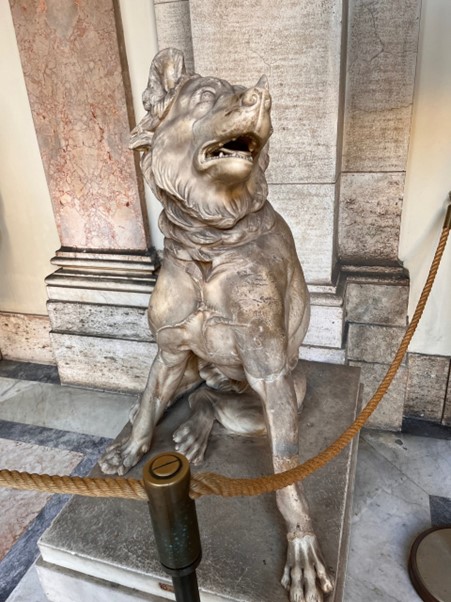
As Thomas W. Laqueur shows at length in his discursive and charming book on dogs in western art history, dogs have always been around us.
Canines were possibly the earliest ‘domesticated’ animal, forming symbiotic bonds with humans at a very early stage of our mutual evolution.
Lacquer speculates that canine domestication acted as a ‘proof of concept’ for humans, living with other than human entities.
We see this close relationship in the representative record.
Dogs weren’t part of the crowd of characters painted on the cave walls of Chauvet (35,000 BCE), but there is evidence that dogs were present in the cave together with humans around 25,000 BCE.
Lacquer reflects on the footprints of a young human and a canine animal found on the site, and wonders if dogs and humans looked at the ancient paintings together: “the first evidence we have”, he writes, “of a dog-like creature doing something with a human”.
Animal representation achieved an early apogee in the Nile valley.
In Egypt, we find depictions of hunting dogs in some of the earliest art that survives, including pots from 3,300 to 3,000 BCE (Naqada III).
Egyptian artists depicted their gods in animal or mixed-human-animal forms, reflecting something of the more than human powers that animals can give to humans.
At various times in human history, people have believed in the existence of so called dog-headed people (cynocephalics).
St Augustine was so concerned, he spent much time reflecting on them:
‘What am I to do with those dog-headed men whose dog’s heads and actual barking show they are more beasts than men’.
But he wisely concluded that if such people existed, they descended from the ‘original and first-created man’ (who was in turn, supposedly, created in the image of God…)
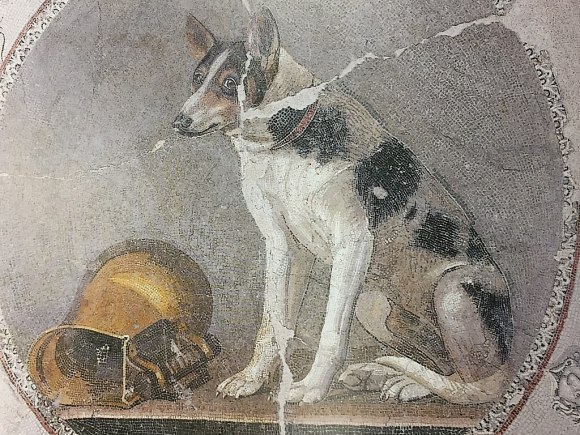
We should understand the human relationships with dogs as one determined by historical forces and contingencies.
Certain qualities remain consistent (if not contradictory with each other): their faithfulness and loyalty, their cheeky sense of mischief, their physical force, their doggedness once they get a scent, their comfort, their association with death.
The latter is intriguing and seems to be found in many places, and so not the outcome of influence but something more inherent to the dog
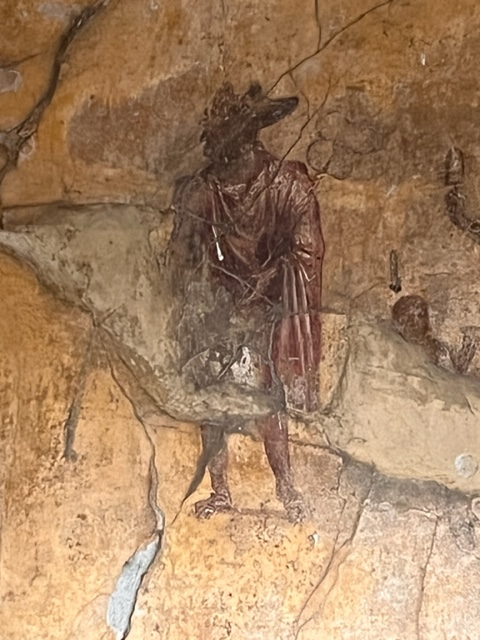
The Egyptian god Anubis is the most obvious example of this.
Some scholars have suggested that the connection with death was due to the presence of scavenging canines close to human remains or the doggy act of digging for food.
But I also wonder if the loyalty of the dog and their emotional expressiveness played a stronger role.
Stories like Greyfriars Bobby in Edinburgh and Hachikō in Tokyo demonstrate their loyalty.
In the Egyptian Osiris myth, as recorded by Plutarch, Anubis helped Isis find her husband’s body and then used his uncanny knowledge to rebuild it.
A powerful metaphor for the goodness of dogs.
In telling the stories of the dog, we are telling the stories of ourselves. Such a trite statement however, belies the underside: the stories we don’t tell, say something more true about ourselves, something we don’t want to admit.
We see this perhaps in the history of vivisection, the ritualised torture and murder of animals for scientific study, especially as practiced in the universities of Europe in the late nineteenth and early twentieth century.
It would be churlish to compare this practice to ancient animal sacrifice: the murder of animals in return for future benefits; science is an empirically tested form of knowledge after all.
But while vivisection created tangible good for humans (and other animals), the level of cruelty should not be underplayed.
In addition, the links between physically harming animals and humans have been studied by several scholars and we might see a link between the justification for animal harm and eugenicist beliefs of contemporary science.
The most powerful section of the book, for me, was the chapter detailing this complex history.
It’s difficult to read.
In 1903, feminist anti-vivesectionists spied on research undertaken on a stray brown dog. After two months, held in cramped cages, subject to various experiments in great pain, the dog was finally killed, ‘knifed to death’.
His murder was a major cause célèbre of its day.
A statue erected in memory of the dog in 1906 in Battersea Park, was destroyed four years later in response to heated protests led by scientists and medical students with legitimate concerns about commemorating the poor dog.

The Dog’s Gaze is largely a study of the ‘Old Masters’ of western art, but it is like Byzantine jewellery, warm gold overstudded with gemlike anecdotes, reminding us with its brilliance, what we owe to dogs, our oldest and truest friends, even when we least deserve it.


