“And now, diligent reader, you are no doubt keen to know what was said next, and what was done. I’d tell you, if to tell you, were allowed; if you were allowed to hear then you might know, but ears and tongue would sin equally, the latter for its profane indiscretion, the former for their unbridled curiosity. Oh, I shall speak, since your desire to hear may be a matter of deep religious longing, and I would not torment you with further anguish, but I shall speak only of what can be revealed to the minds of the uninitiated without need for subsequent atonement, things which though you have heard them, you may well not understand. So listen, and believe in what is true. I reached the very gates of death and, treading Proserpine’s threshold, yet passed through all the elements and returned. I have seen the sun at midnight shining brightly. I have entered the presence of the gods below and the presence of the gods above, and I have paid due reverence before them.”
We should expect that a person who has been first turned into a donkey, by witchcraft, and then transformed back into a human by the power of the gods, would be quite trusting to divine rituals. And so it is with Lucius, the hero of the Golden Ass by Apuleius, who undergoes three expensive and time consuming initiation processes, and comes out of it a better man.
Reflections on the Golden Ass by Apuleius
Re-reading the Golden Ass and reflecting on what lessons for life it may provide us.

For the Isis cults, the strongest evidence we have for initiation comes from the final book (essentially modern day chapter) of the Golden Ass, a humorous novel from the second century CE written by Apuleius.
The final book begins with Lucius having a vision of the goddess Isis, who tells him to eat roses carried by one of her priests. The following day, during a festival to start the sailing season, Lucius eats the roses and is transformed back into a man.
The religious subject matter and ostensibly more pious tone of this final book contrasts with the more salacious tone of the previous ten books. Throughout, Lucius experiences the highs and lows of Roman society: robbery, greed and sexual excess, all in the form of a lowly donkey.
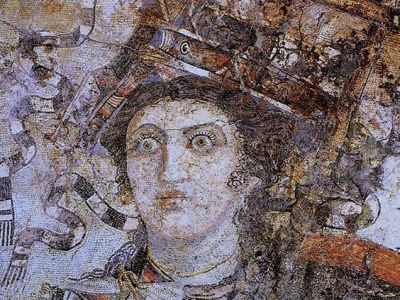
Isis, goddess of the seas and the Navigium Isidis
Celebrate the beginning of the maritime season with Isis
But there are religious aspects throughout. The novel is full of ‘exotic’ gods, including a reference to the Celtic-equine-inflected-goddess Epona and the Magna Mater.
The links to Isis, earlier in the novel are more allusive, although many people note that the donkey was one of the animal forms of Isis’ great rival Seth. Her transformation of Lucius, becomes a struggle against Seth. I personally think this over-reads the novel. Also, Apuleius was drawing on an earlier tale of asinine transformations.
In the reading I prefer, Lucius needs to reject desire for virtue, which he does when he refuses to have sex in public and runs away to the sea shore. Here, after washing himself in the sea, still a donkey, seven times, a number important to Pythagoras, Lucius has a vision of the goddess. (Sea bathing was part of the ritual practice that developed in the rituals at Eleusis.)
Overwhelmed with gratitude Lucius dedicates himself to the goddess and decides to be initiated, eventually undergoing three rites.
The first in Greece, takes place in the same temple in which he had lived after transformation. Apuleius offers some intriguing details about the practices involved in the temple: He describes daily ablution of the statue of Isis made with water from a well in the temple, books of hieroglyphs and dream incubations.
Of the initiatory teaching itself, he is tight lipped, “I’d tell you”, he says, “if to tell you, were allowed”. But he describes what he did.
First the ceremony seems to involve some form of testing. The chief priest (called Mithras) will not initiate Apuleius until he is ready (more precisely, until the goddess indicates he is ready). Apuleius does not describe any formal teaching taking place before the initiation, but he does hang around the temple a lot. He is given the go ahead by Isis, via dreams.
At this point, he abstains from meat for ten days, goes to the public baths for a ritual cleansing and buys new clothes.
During the heart of the ceremony, he undergoes a form of psychedelic ecstasy:
“I reached the very gates of death and, treading Proserpine’s threshold, yet passed through all the elements and returned. I have seen the sun at midnight shining brightly. I have entered the presence of the gods below and the presence of the gods above, and I have paid due reverence before them.”
Although this sounds like a fantastic experience, the book notes that some people undergo initiation at the point of death. A practice undertaken in other forms of religious onboarding (like Christianity) at the time. For example, Constantine the Great was only baptised on his death bed.
Following the groovy night, Lucius is then dressed in special clothing, given a torch and a wreath of palm leaves and stands as a statue, to be presented to the initiates.
“Adorned thus in the likeness of the Sun, and standing there like a statue, the curtains suddenly being opened”
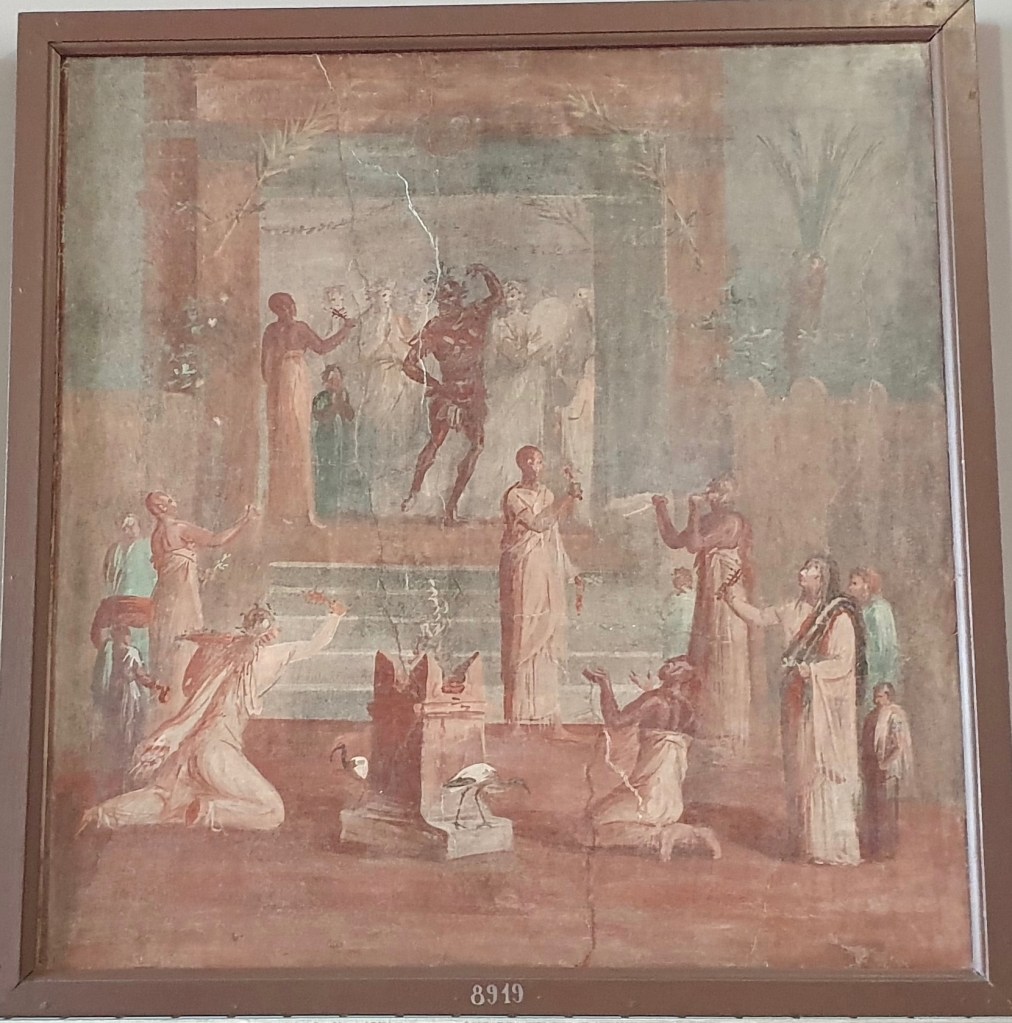
This description resembles an image found on a wall painting in Herculaneum. A man is presented to a crowd of worshippers. He appears to be painted or smeared in some form of mud or shining material. We cannot be sure that the Herculaneum image depicts a moment of initiation at all, but it does suggest that forms of religious drama took place in Isis temples. (The painting from Herculaneum was also painted around 100 years before the Golden Ass was written).
[Photo of Herculaneum]
The ceremony is followed by a feast with the other initiates.
Although many scholars focus on the mystical elements of initiation, we should not ignore the aspects of sociability.
Connections made in the temples and religious associations will have helped people get on in life and must surely have encouraged take up, as well as religious belief.
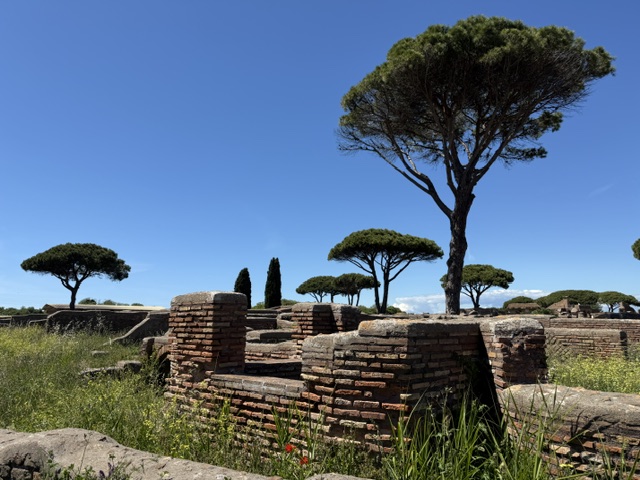
Apuleius leaves Greece and sails to Rome, via Ostia, to a successful career in law. He worships regularly in the Isis Temple in the Field of Mars. Soon, he realises, he has not been initiated into the rites of Osiris.
Although he pleads poverty the god calls to him a dream “Surely … you’d not hesitate to pawn your rags to fund your idle pleasures, so why now, on the brink of a vital act, do you brood on a state of poverty which will bring not a single regret?”
Even after this he has a third intervention from on high. “Not long afterwards, I was again presented in a dream with the sudden and startling demand from the deities for yet a third initiation”.
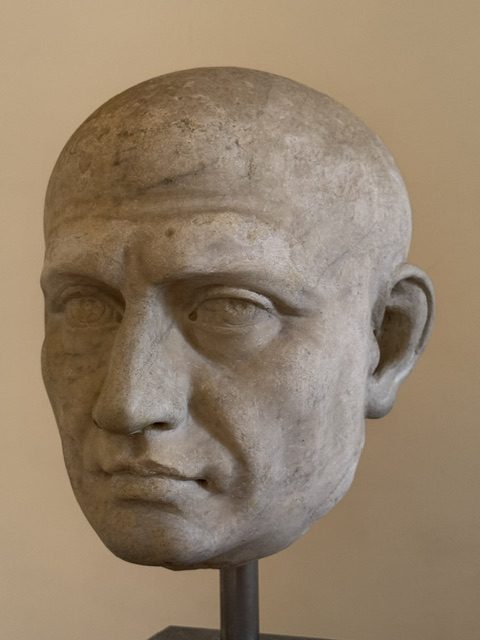
“Finally, a few days later, Osiris, greatest of the gods, highest among the greatest, mightiest among the highest, lord of the mightiest, appeared to me in dream, and not in some semblance other than his own, but greeting me face to face, in sacred utterance urging me to win fame as now in the courts through my advocacy, without fear of the slanders provoked by my assiduous study of the laws of Rome. Furthermore, I was not to serve him as a minor member of the flock, but as one his college of pastophori, the shrine-bearers, and a member of the quinquennial council.
Once again then I shaved my head completely, and not hiding my baldness covertly, but displaying it proudly wherever I passed, I performed with joy the duties of that venerable priesthood, founded in the days of Sulla.”
So, Lucius finds himself at the end of the novel, a successful lawyer and a member of the pastophori, the shrine-bearers, an important group in the most important Isis temple in Rome.
Apuleius implies that non-initiations could be involved with the Isis temple to a certain level, participating in processions and some parts of the temple. But to engage more fully, they needed to undergo a level of initiation.
While this section of the Golden Ass is rich in detail, we should be careful not to apply it to all Isis temples in every location and at every time.

The Secret Sacred
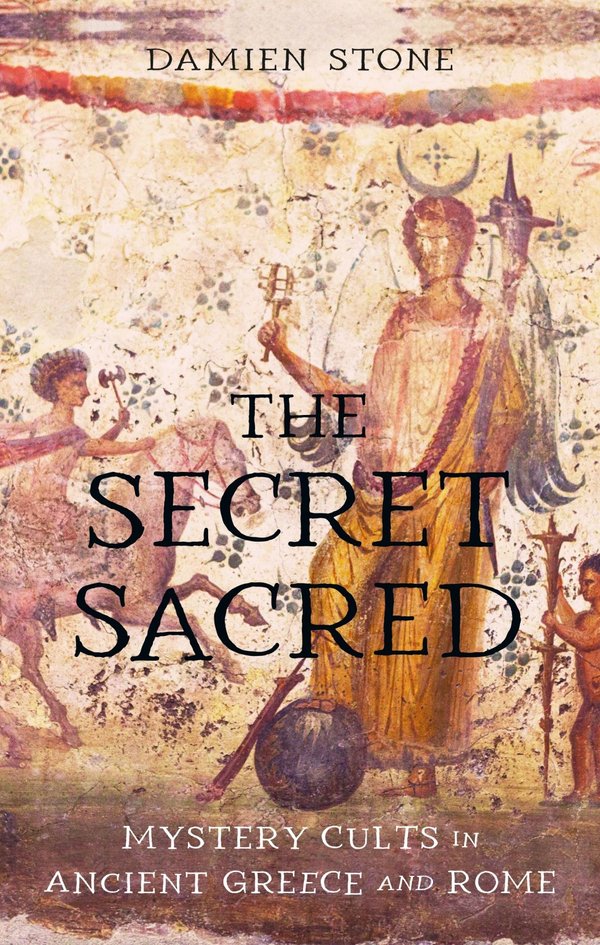
People seeking more information on the mystery cults, could do worse than read The Secret Sacred written by archaeologist Damien Stone and recently published by Reaktion.
In his short, illuminating and readable book, Stone discusses the main mystery religions, ‘the various cults of Classical antiquity that offered secret wisdom to their members’.
He starts with Eleusis and goes through the cults of the Samothracian gods, Orphism, Mithras and one of my favourite serpent gods, Glycon.
These cults offered a personal relationship with the divine and hope in a sometimes bleak world.
For much of the history of modern scholarship, they were read in the context of Christianity, which Stone only briefly touches on.
This is understandable given how dense and off-putting this topic can be for many readers, but there is a rich world of weirdness in early christianities.
Instead, he uses the example of spinning classes to demonstrate the overpowering sense of freedom struggling through the dark and into the light of ‘pure bliss’.
“Sometimes”, he writes, “I experience an out-of-body sensation while cycling. Closing my eyes deep into a class, I lose cognizance of the setting. The music penetrates my being and vivid imagery manifests in my mind’s eye”.
A powerful explanation of why mystery religions, inspired people then and now.


#/media/File:Priests_of_Isis_perform_a_ritual.jpg)