
St Augustine and Africa
A few days after his patient exchange of ideas with the American Vice President, JD Nonce, Pope Leo XIV visited the archaeological site of Annaba in Algeria, the location of St Augustine’s basilica.
Leo has long standing connections to the saint. He wrote his doctorate on him, and later became head of the Augustinian Friars. So, it was natural on the flight to Algeria, the Pope read a book about him, Augustine the African, a new biography by the academic Catherine Conybeare.
Conybeare attempts to place Augustine within his African context. She does this in mostly accessible language, avoiding technical terms and side stepping complex historiographical disputes. For her, his African identity provided a perspective that was at once aware of the brutal reality of Roman political power and believed in its more spiritual power.
The parallels to the present day are uncanny.
Was Augustine African?
This is obviously a very topical question, not least because in countries like the USA and UK we have white supremacist political parties in power or seemingly on the cusp of power.
Augustine was born in modern day Algeria. His father was likely of Roman origin and his mother (later canonised as St Monica) likely of Berber origin. He grew up surrounded by Punic speakers and had some knowledge and interest in the language. He was never a fluent speaker, but then he also struggled with Greek.
As a teenager, he was drawn to local heroes like Dido and Hannibal, famed Carthaginian enemies of Rome.
Later, while still young, during his highly successful stay in Italy, he was acquainted with powerful figures surrounding the imperial court, like Ambrose, Bishop of Milan. But his closest circle were his African friends. He was also made aware of his African accent, via comments from snotty nosed Italian students.
Most tellingly, when writing of the immortal Apuleius (author of the Golden Ass), Augustine said ‘being an African, [he] is better known to us Africans’.
Yet Augustine’s African identity has to be caveated with the fact that Africa largely meant the province of Africa Proconsularis, formed from the remnants of the shattered Carthaginian Empire and located in a narrow part of the continent’s Northern coast (modern Tunisia, Algeria and Libya).
And for a figure famed for his power of speech, this statement should also be tested by what he did and not just what he said.
The African church
At the heart of Augustine’s pastoral work as priest, was his support in the efforts to crush a form of Christianity, commonly called Donatism, which emerged from the painful years of persecution in the previous centuries, when some Christian leaders handed over religious books for the Roman authorities to burn and others did not. It is hard to imagine what we would do in such a situation. By Augustine’s period, the two groups had solidified with each claiming they had authority to perform sacraments like baptism, holy orders and eucharist.
The question to whether Donatists were linked to Punic speaking Africans and Catholics to Latin speakers remains a charged and thorny question. But I’m not sure how much Cornybeare’s labels ‘the African church’ and ‘the church in Africa’ helps the lay person navigate this tricky topic. The terms have parallels with English church history: ‘the Church in England’, a term for the pre-Reformation church and post-Reformation Roman Catholic church led by the Pope and ‘the Church of England’, a term for the Anglican post-reformation church headed by the monarch (currently Charles Mountbatten-Windsor). But in Africa, there was an imperially sanctioned church faction.
The situation in Africa became violent. The imperial forces turned on the African Christians, in return, gangs of youths attacked Catholic priests.
Augustine took them on, using the curse word ‘circumcellions’ to describe them. It refers to seasonal workers, often underemployed during slack time and accused of resorting to violence for kicks. A particular trick was said to be smearing a mixture of lime and vinegar in their victim’s eyes to torture and blind them.
There is a possibility an African based usurper had used this group as a powerbase to take on the Western Emperor. Augustine used this as an attack line in several texts, justifying if not goading on pressure.
In most cases, the imperial sponsored church was the stronger side, extrajudicially murdering opponents as required. One important bishop was thrown off a cliff. Augustine’s response to the killing of Christians was to make jokes. When he asked, did the Roman state throw people around? Seemingly forgetting what happened to the founder of his faith, that unseasonably gloomy day nearly 400 years before.
“Neither side comes out of the story well”, Corybeare concedes about the whole conflict.
In 411 CE, the tension culminated in a church council! Five hundred bishops from both sides met in a bathhouse in Carthage. It started with a roll call of all 500. Marcellinus the chair suggested ten bishops was enough to represent the whole, but no the Donatist leader Petilian demanded all present to announce themselves. A poignant display of power and courage. The confession of faith took the whole of the first day.
In the subsequent two days, each side fielded their strongest disputants. Augustine was not great. Long-winded and self-important, he was often interrupted. You can sense the frustration on the Donatist side. But it surprised no one that Augustine’s side won. Donatists were forced to convert and congregations to merge.
What is perhaps surprising about this event is that it all took place only a year after the Sack of Rome. To secular readers this may seem like arranging deckchairs on the Titanic, but it shows the complex mix of religion and power and the administrative importance of church hierarchy at this time.
The unconverted self
Augustine was at the centre of the Roman state’s attempt to control the African church. This does not negate Augustine’s African identity but it complicates it.
At the heart of the saint’s life and work, is a tension between power and truth, the things of the world and the world that is to come, wanting to win arguments and seeking peace, personal ambition and humility.
For Christians like Leo, Augustine provides a framework for interacting with the world, because he successfully navigated this division.
For me, as an unrepentant agnostic, much of the power of his work and what draws me to him as a student of history, comes specifically from the fact that it is never resolved. He presents an image of a person uneasily struggling to reconcile different aspects of his self, his beliefs and his place in the world.
I believe of many recent biographies of the saint, Conybeare gets closest to reconciling the different aspects of Augustine’s theology, which can only deepen our understanding of his context and I think the contemporary context in which theology and politics are once again awkwardly entwined.
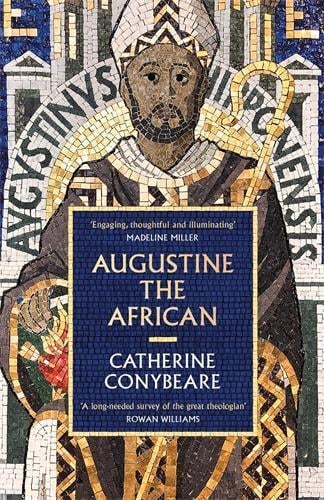
(Book cover used under Fair Use)

