Egypt is the source of all the world’s culture.
Herodutus tells a story about Hecateus, a Greek historian. He was discussing lineages with an Aegyptian Priest in Thebes. Hecateus claimed to be the distant descendant of a god. He traced his forebears back to sixteen generations.
The priest is having none of it. He takes the historian to a room full of wooden statues of earlier Priests. Each put up in succession. He makes Hecateus count them all. 345 and not a god amongst them.
“You Greeks are just children.”
Egyptian art is often read as a cultural cul-de-sac. Fascinating, alluring, gorgeous, but a cul-de-sac nonetheless. This is perhaps says more about the worldview of modern Western scholars who “rediscovered” Egypt in the early Nineteenth Century. We should perhaps consider that Egypt was a major source of knowledge for Greek and Arab thinkers, a great influence in art and thought and a touchstone of civilisation.
Ancient Egyptomania
Even in antiquity, other cultures prized and borrowed elements of Egyptian art. Craftspeople in Mesopotamia may have been influenced by the temple reliefs of Egypt. Egyptian style objects have been excavated in Nimrud, capital of thee Neo-Assyrian empire (911 – 605 BCE). The cosmopolitan architecture in Persepolis (built 518-16 BCE), which merged elements from different cultures, drew in part from Egyptian architectural style with sumptuous cavetto cornices.

Homeric Greeks
The first interaction between Egyptian and Greek traders took place during the Myceanean period. Small Egyptian gods have been found across the Meditterean outside Egypt. A statue of the god Amun in Egypt, Bastet in Cyrpus and scarabs all over.
More intriguing perhaps are the works of the Late Geometric and Orientalising period. Jars showing Sphinx like shapes and other animals
This was the period of the Trojan War and Egypt is mentioned briefly in the works of Homer. When Paris and Helen flee the court of Menelaus in Paris, they first head to Egypt. Their steerman Canopus is drowned in the sea and gave his name to the town in Egypt (also known as Pikuat).
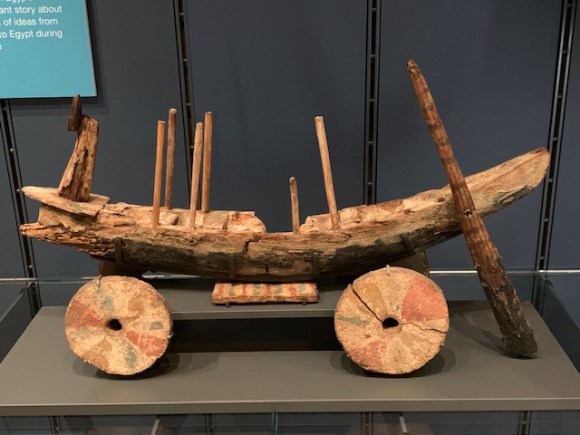
An intriguing object that gives some evidence for this interaction is the Gurob Boat Model held by the Petrie Museum in London. It is a model of a Mycenaean ship with its blach hulls. In the words of Shelley Wachsmann “if Helen of Troy’s face launched a thousand ships, then at present the Gurob model is the nearest we can approach to that ship type”.
Over 1,000 Egyptian-style objects have been discovered in the Temple of Hera on the Greek island of Samos, set in the gorgeous blues of the Aegean Sea. This includes over 600 items in faience, 200 in bronze and other objects in alabaster and ivory. These largely date to Dynasty 26. The bronzes represent male Egyptian gods – Bes, Harpocrates, Horus, Ptah and Reshef. Only two bronzes of goddesses have been found, identified as Neith and Mut. Bronze statuettes of Egyptian gods outside of Egypt are rare. The items were likely dedicated in the temple as votive objects for the goddess Hera.
 Rhakotis