
Marguerite Yourcenar was born on 8 June 1903 in Brussels. Yourcenar published several novels, gained many prestigious awards and was the first woman and the first lesbian elected to the Académie Française.
She met and fell in love with her life partner Grace Frick (an American) in Paris, before the two women moved to the states at the outbreak of the second world war. They lived in Maine for the rest of their lives. Frick acted as Yourcenar’s translator and researcher for the rest of her life.
She is best known to English readers for the Memoirs of Hadrian published in 1951. The novel had a long gestation. Yourcenar had the idea for the novel in the 1920s, before beginning work on in the 1930s and finally finishing it in the late 1940s. It is written as an extended letter to Hadrian’s successor Marcus Aurelius and shows a level of psychological, philosophical and historical insight rarely seen in works of fiction or nonfiction.
The most powerful position a mortal human has ever achieved might be presumed to be Roman Emperor. He ruled, even if we avoid cliches like ‘the whole known world’, then at least a very large chunk of it, with that strange combination of absolute power over life and death, a fragility against usurpation and an inability to enforce his writ beyond his immediate area, which was part of the nature of ancient kingship.
It is perhaps notable that the more vintage historical novels set in the Roman Empire that have lasted have are all centered on Emperors. These are I, Claudius, Julian and Memoirs of Hadrian. If Robert Graves’ fictional autobiography of the Emperor Claudius plays up on the scandal and gossip of the Julio-Claudian family, then Yourcenar introduced a new voice and more inwardly looking perspective that has inspired many later novelists and still beguiles today.
The Emperor Hadrian can be taken as one of the most powerful people to have ever lived, ruling the empire for 21 years during the period of its greatest size. He had experienced the violent reality of Roman military both as an officer and then military commander leading the brutal war against Jewish opponents in the Bar Kochba Revolution.

Yourcenar understands Hadrian within the constraints, the horizon, of his being as a leader of an ancient society, fueled by enslavement and military exploits. He transcends these constraints, while never ceasing to be that which he is: a Roman emperor.
There is a complex and multi-levelled truth, that we sense as readers, but which forever recedes as we get close to it. Too often historical fiction either explains away historical facts or attempts to ‘ironically’ revel in it. This book is almost unique in its ability to locate itself fully in the past, but give agency to its characters which paradoxically allows them to be judged by posterity (us).
This is what makes Memoirs of Hadrian a great book.
In Yourcenar’s telling, the experiences of war have molded Hadrian the man. He was hardened by early experiences in the field. He is without either sentimentality or cruelty. He reflects that the annihilation of the Dacians had been justified because their presence might be a threat to the Roman frontiers, even if the power void created by Roman victory brought the Sarmatians to the frontiers in a land ‘burnt and reburnt by us’. But witnessing the torture of old men and children during the Roman War is depressing. Witnessing, it is to be noted, not ordering but also not stopping.
War formed the man, but it did not define him. The novel begins with Hadrian accepting the unchangeable nature of his own mortality, ‘an accepted defeat’. He suffers from sleeplessness and measures himself against other people. He is reflecting on his life, and passions as an elderly and dying man.
Hadrian is best remembered today for his two great loves: Greece and Antinous.
He traveled around the empire, but it was Greece he loved best. Athens was largely rebuilt during this time. An arch was set up in his honour. On one side it said ‘Thesius made this’ and on the other ‘Hadrian made this’ (my very rough translation).
Antinous was a young man whom Hadrian loved. He drowned on a trip to Egypt and was turned into a god. It is hinted in the novel that he intentionally killed himself, perhaps for magical reasons. The two men have become symbols of love, and especially homosexual love. The novel explores both the physical and emotional side of this love on Hadrian. It was a consensual relationship, but was one in which there was an inbalance of power.
Even at his best moments, Hadrian is a complex character.

While the psychology of the emperor is a major focus of the novel, Yourcenar understood that a major reason we are interested the Roman Emperor was not just because it was an empire of men, but more precisely it was an empire of the imagination. It stood not just the idealization of classical ideals, but more pertinently for the destruction of that ideal.
One way to begin questioning classical ‘ideals b’values’ is to understood their historical baggage.
We approach the classical past through ruins and fragmented, thickened like fats in the sewer by the artistic accretions of the centuries.
Even Hadrian approached the past alive to the sense of loss. His beloved Greece bore the scars of Roman power, “crimes” he calls them: the ruins of Corinth destroyed by Lucius Mummius and the temples emptied of their treasures by Nero. While Hadrian rebuilt Greece and other provinces, he also understood something of this distance of time.
I have rebuilt a lot: it is collaborating with time in its aspect of thought, seizing or modifying its spirit, serving as a relay towards a longer future; it is to find under the stones the secret of the sources. Our life is short: we constantly talk about the centuries that precede or follow ours as if they were totally foreign to us; I touched it, however, in my games with stone. These walls that I prop up are still warm from the contact of the bodies that have disappeared; hands that do not yet exist will caress these column shafts.
Pg. 141
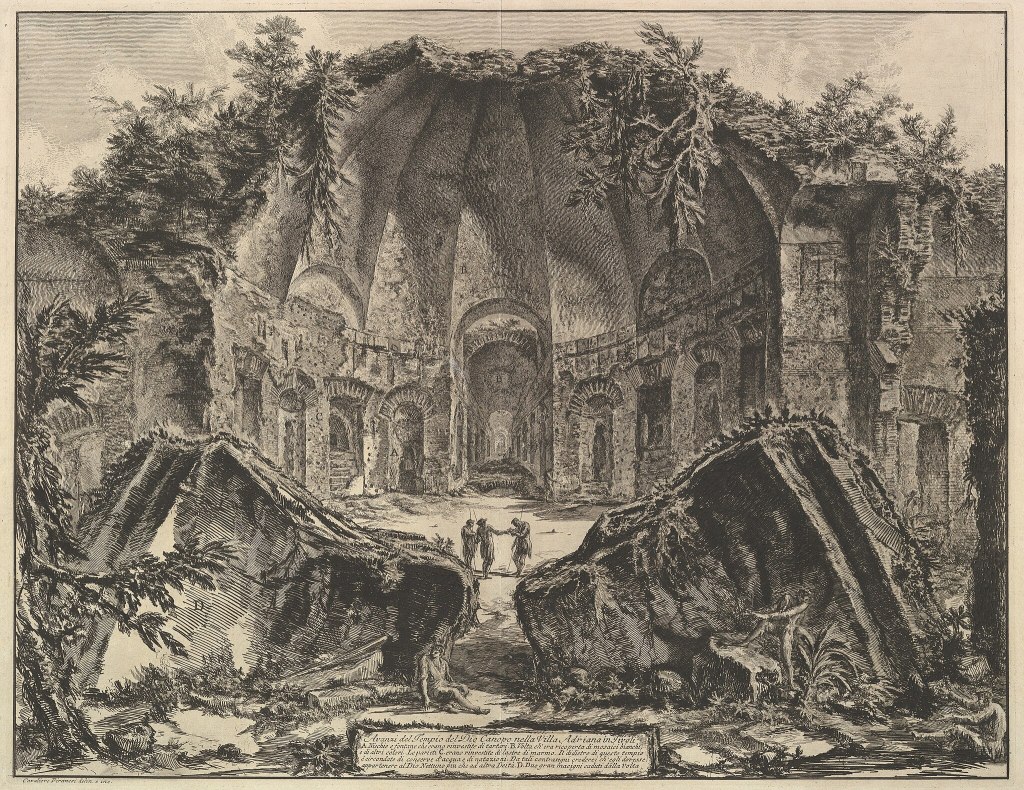
Yourcenar and Frick had a print by Piranesis of Hadrian’s villa in Tivoli above their fireplace in the house in Maine. The print depicts the great dome of the Canopus, which once housed a statue to Antinous and which still dominates over the fragile silhouettes of the men in the middle distance, is itself ruined, covered with vegetation, shrouded in shadow. It is an impressive and melancholic, which suggests the power and majesty of Rome by its loss.
Visiting a site like Tivoli, or indeed reading a first hand novel, you get the sense of immediacy. Hadrian too was here once. Yet in Yourcenar’s imagination, Hadrian understood how someone viewing the ruins in centuries hence might feel.
Reading Memoirs of Hadrian you get the uncanny sense, not that you are reading his thoughts, but that he is reading yours.
Top photo: Marguerite Yourcenar (1903-1987) – foto De Grendel Bernhard in 1982 (CC BY-SA 4.0)
 Rhakotis
_MET_DP828287.jpg)


.jpg)
.jpg:~:text=View%20more-,CC%20BY%2DSA%204.0,-view%20terms)