Most great civilisations are measured by the fruits of their highest achievements, the size of their ruins, the subtlety of their fine arts, the many piled splendours of their tombs.
Egypt alone, perhaps, is measured by another thing: the treatment of its workers.
The biblical narrative of servitude in Egypt, has informed a reading of the Nilotic civilisation that persists to this day.
Gorgeous, golden pharaohs overseeing enslaved populations dragging massive blocks of stone to build their pyramids and temples is an image etched on our collective imagination.
Without dismissing the horrors of slavery, which were certainly true, modern research has revealed another side of ancient labour.
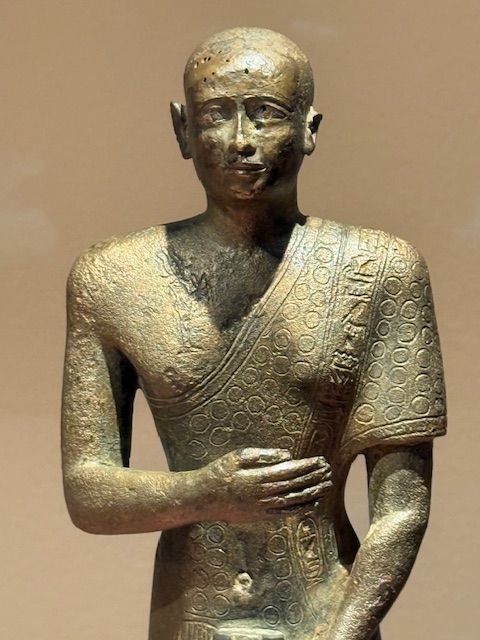
Egypt was full of skilled workers (hemut), practising a range of crafts including sculpture, goldsmithing and glass.
A new exhibition, currently on at the Fitzwilliam Museum until 12 April, aims to shed light on this less well known aspect of ancient history.
The exhibition is organised by the craft, using the Fitzwilliam’s own collection and loans from other museums. It explores workers in stone, potters, makers of faience and glass, metal workers, jewellers, makers of linen and baskets, wood workers, makers of papyrus and coffin makers.
The exhibition also used large copies of Egyptian art (painted by Nina M Davies, in the 20s) to show how the objects on display were made. In a few cases, these were animated by Tomfoolery Ltd.
There are also interactive activities, like a bow drill and a basket weaving station. These make the exhibition more accessible to young visitors, but they also highlight the hard work and physical skill of the workers.
But ultimately the show was really about the artefacts themselves. The pieces selected were high energy, virtuoso, exquisite objects: gold, precious stones, figurines, ceramics, paintings.
A highlight for me were the works in progress, the makers’ models, the objects that reveal something of their creation and duplication.
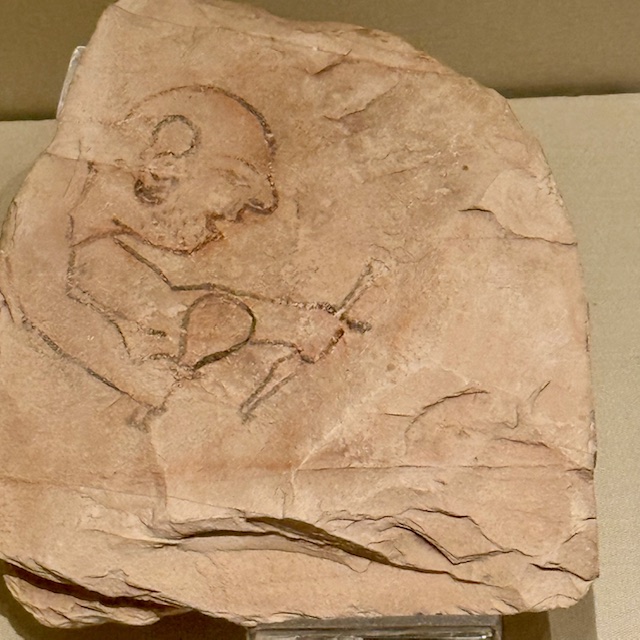
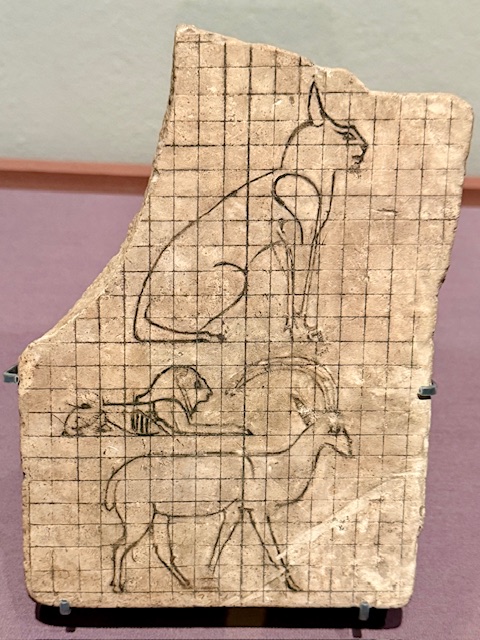
An ostracon (piece of stone), with grid lines and the shapes of a cat, lion and antelope show a young artist how to depict animals in an Egyptian style.
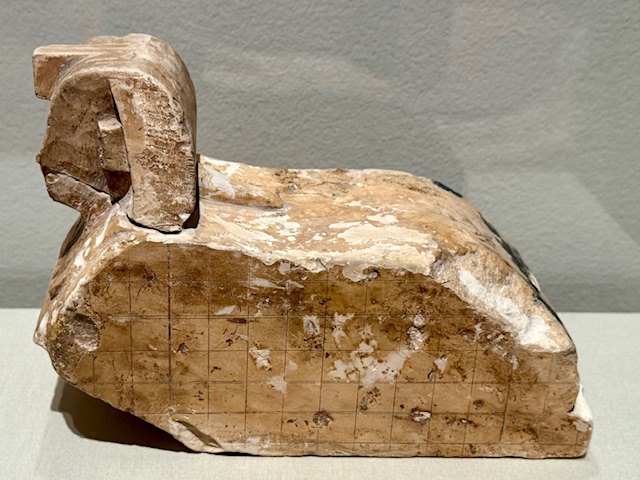
A cuboid sphinx emerging from limestone, the face half formed but the body is still held in potential in a superellipsoid, almost like a hatchling cracking the shell with its beak and emerging from the egg. This is not an unfinished work, but a sculptor’s model perhaps used as a teaching tool.
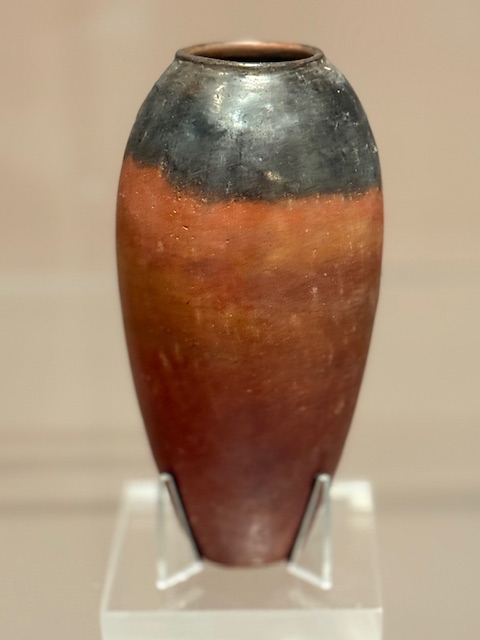
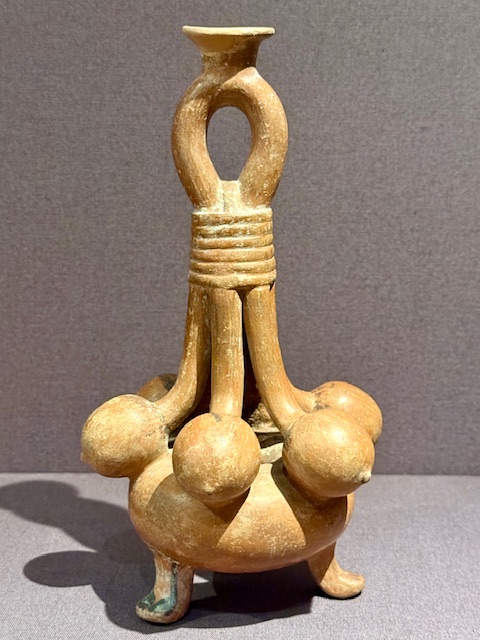
This mandrake fruit vessel has long been a personal favourite in the Fitzwilliam’s Egypt galleries. I had not realised it was found in a tomb with other ceramics linked to childbirth and may have been chosen because the mandrake resembles a human breast (an important symbol in ancient Egyptian art). CT scanning has shown that the potter used a combination of molded and hand made parts and then burnished and decorated it before firing.
In this way, the curators focus on the creative powers and imagination of the workers.
The exhibition highlighted the work of skilled artistic labourers and given the remit of an art gallery, this is fair, but I would have liked a little bit more on other forms of labour, including unskilled and semi-skilled, that underpinned the ancient ‘economy’. The miners digging for stone, the agricultural workers growing the linen, the sailors responsible for bringing raw materials to Egypt.
But it is a small exhibition space and I think the curators have struck the right balance on what to display.
Visitors will be beguiled and inspired to find out more.
 Rhakotis