Traditionally the date of the eruption was given as 24 August 79 CE but recent research has suggested a later date of 24-25 October 79 CE.
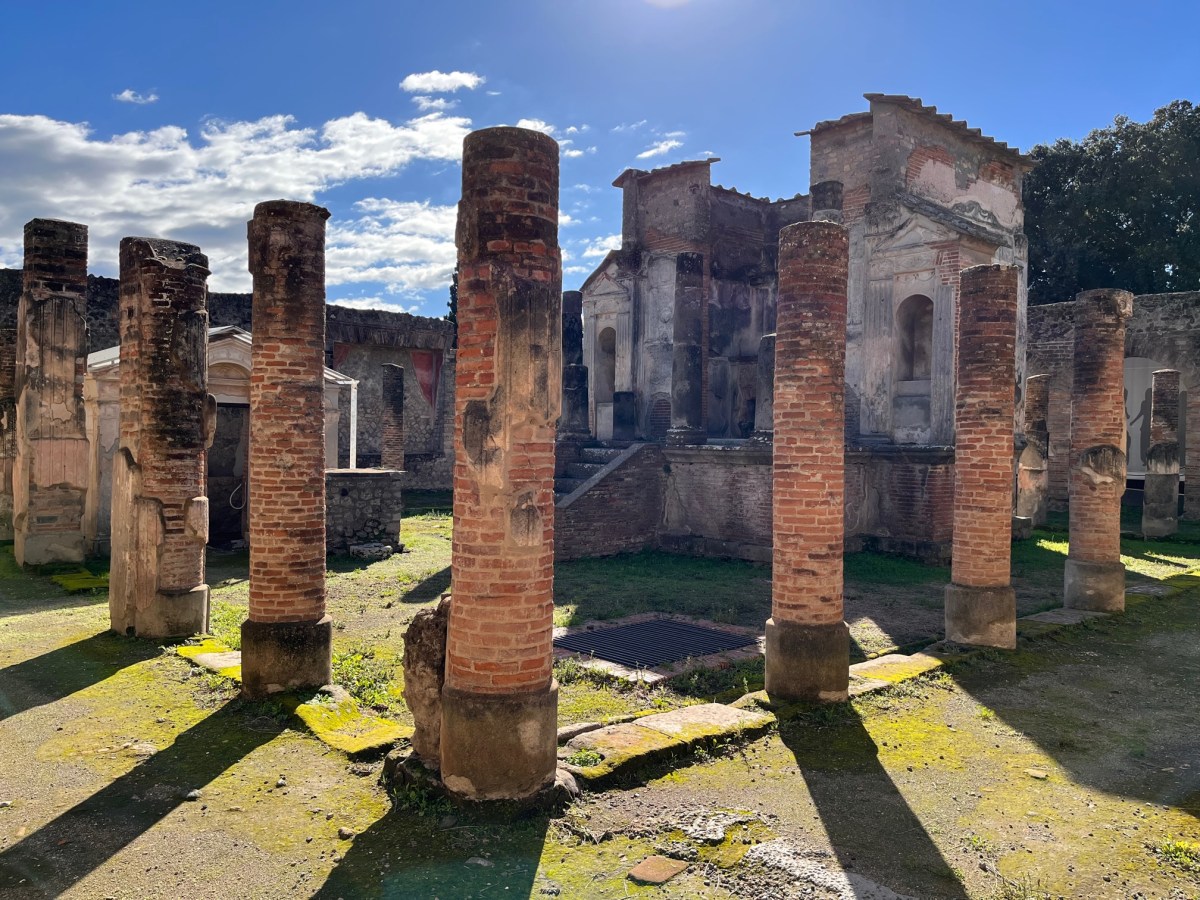
One of the first big discoveries at Pompeii was a skeleton, still holding a bag of valuable items, in a building covered with strange symbols and images. The building was quickly identified as a Temple of Isis.
The image caught the gothic, heightened imagination of the first generations to visit Pompeii. Mozart may have drawn on the story and his own memories of the archaeological site when he wrote The Magic Flute, while Mr Sir Edward Bulwer-Lytton made the city’s Isis Priest a main character in his novel The Last Days of Pompeii.
Egypt in Pompeii
Pompeii is remembered as a Roman city, but this misrepresents a more fluid identity.
During the city’s long history, it has been home to different groups, including Samnites and Etruscans, who brought their own traditions to the city. More importantly, the sea connected Pompeii to other regions. The port of Puteoli (modern day Pozzuoli) on the other side of the Gulf of Naples was the most important entry route into Italy for trade goods from across the Mediterranean, connected to other ports through long established trade routes, that went back centuries, predating Roman control of the seas.
Among other things, the region was an important landing stage for Egyptian goods and traders.
In the strange combination of utility and luxury that the Romans were noted for, the trade dock of Puteoli was located not just next to the military dock of Misenum but also to the luxury holiday resort of Baiea, noted for its oyster beds.
Pompeii was full of Egyptian items, ranging from luxurious high-class artworks (like statues or wall paintings) on one level to more mundane objects (like papyrus, cotton and grain) on the other. In the city’s final century before destruction, Egypt has become an important part of the Roman Empire. This would have affected how Egypt was received. It’s complex.
Another trade good also landed in the city: gods.
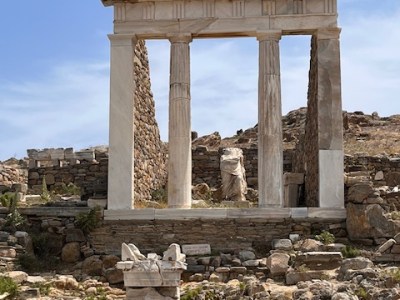
Italy’s first temple to the Egyptian gods was built in Puteoli in 122 BCE. The Greek island of Delos seems to have acted as the mediator between Egypt and Italy. Delos was an important maritime hub, strategically located in the middle of several important trade centers. It was a tiny island. The specific choice of Egyptian gods worshiped on Delos resembles that of Italy. For example, the French historian, Michel Malaise has argued that Anubis is attested in both Delos and Campania. We do not know for sure who built the first temple. Whether it was built by Italians who had visited Delos or Delians based in Italy, but the religion spread beyond this initial group.

Temple
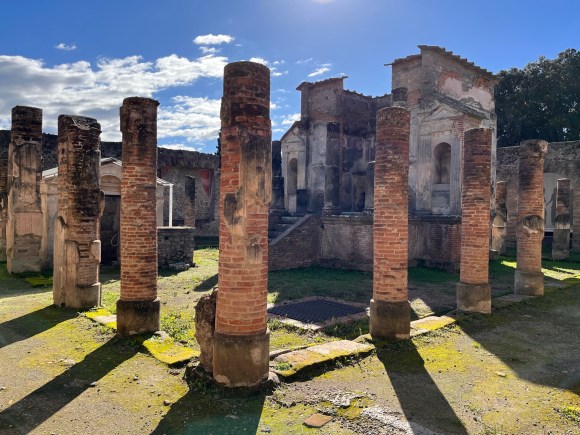
Pompeii’s temple to Isis is dated from this period as well. It was built in a public region between the civic gymnasium (Samnite Palaestra) and the theater, not far from the city’s main thoroughfare, the Via Della Abbondanza.
It had been repaired following the major earthquake of 62 CE, following a donation paid by Numerius Popidius Celsinus, a formerly enslaved person, whose six year old son was made a council member in recognition of his father’s civic generosity. Numerius could not take this position himself. The act of donating money towards the temple had a clear political objective, which suggests the cult was relatively important and popular in the city. Numerius also dedicated several cult objects within the temple in his own name.

The ‘temple’ is better understood as a walled enclosure, with a smaller temple in the middle (and rooms off to the side). The courtyard was designed to allow for the gathering of crowds and processions; the main altar is asymmetrically placed before the entrance to the Temple proper.
The temple was covered in wall paintings, which were removed during the initial excavations at Pompeii and placed in the Archaeological Museum in Naples.
Around the podium have been found statues or statue bases of Harpocrates, Bacchus, Venus and the bust of an actor. On the podium temple itself, there are two niches either side of the entrance with small stone altars in front of them. Although no statues have been found for these niches, it has been suggested that these housed statues of Anubis and Harpocrates, both commonly attested in the small domestic shrines found in most houses.

Within the temple building itself, there are two statue bases for Isis and Serapis. An over life sized head of the goddess has been discovered, which may have been the cult statue or used in communal dining. In the portico of the courtyard, there is also a painted frieze depicting a procession of priests and priestesses including a priest wearing a mask of Anubis.
The Temple was an important center for organising the life of the cult and we might speculate that it hosted regular daily ceremonies and festivals, including perhaps processions through the streets of Pompeii.
A wall painting from Herculaneum depicts an Egyptian temple, at the moment that the priest presents a small vase. This image resembles a passage from The Golden Ass by Apuleius
Although it loosely resembles the Pompeii temple, it is not meant to be an accurate depiction of the building. The presence of palm trees, sphinges and ibises (a black and white bird, synonymous with Egypt in Pompiian art) may mean the temple is set in Egypt. However, the painting reveals something of every day rituals. The painting depicts at least six religious officials, as well as many members in white linen robes with shaved heads (a description we know from other sources). A flautist plays an instrument in the bottom right corner, while the audience shake their rattles (or sistrums, a cult item also known in Egypt). It is a moment of great excitement.
(While Egyptian items have been excavated in Herculaneum, no temple has yet been found.)
Domestic religion
The Egyptian gods were also worshiped in domestic settings across the city. The nature of these cults are subject to a lot of scholarly dispute, but they were presumably understood to have a protective or beneficial role to some or all members of the household.
It is useful to analyze some examples of domestic shrines in turn, but first we can touch on an important general trend: Isis and Harpocrates are important figures, but Serapis is a relatively obscure god, identifiable in only two shrines. Vincent Tran Tam Tinh argues that sentimentality prevailed in Pompeii.
House of the Gilded Cupids
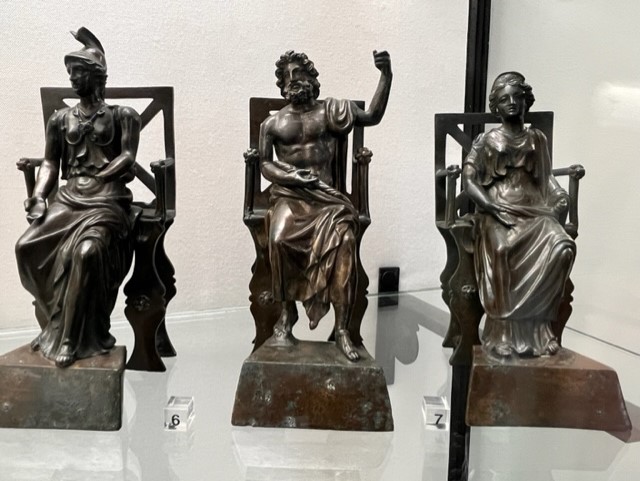
The House of the Gilded Cupids (Regio VI) was a particularly large and luxuriously decorated building, housing two domestic shrines in the peristyle around the central garden. Both shrines are visible from the reception areas. The first shrine, dated to 80 BCE, is located in an aedicula (or small model of a temple). It contained six statues: the Capitoline triad of Jupiter, Juno and Minerva, a bronze Mercury and two standing lares. This is the only example of the Capitoline Triad in a domestic context in Pompeii.
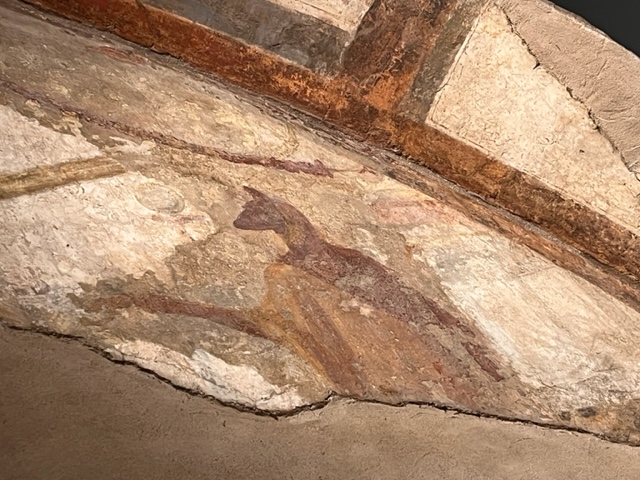
The second shrine, dated after 62 CE, is painted on the South-Eastern corner across two wall spaces. One wall shows items linked to the Egyptian gods and the second wall shows the gods themselves. Anubis wears a red robe. He looks to his right towards Isis.
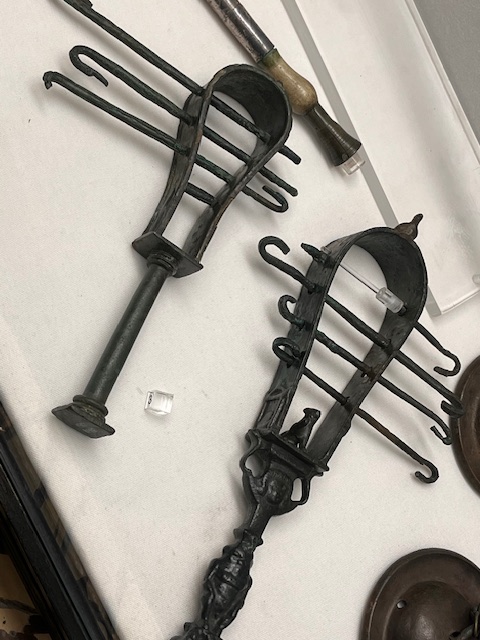
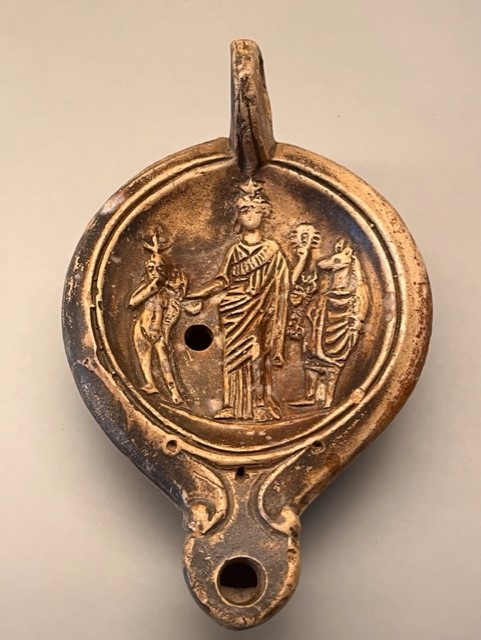
Nails have been found by the corner which archaeologists have argued were used to hold shelves containing objects or offerings. Several items were found close by including a marble statue of an enthroned Fortuna (perhaps identifiable with Isis-Fortuna), an alabaster statue of Harpocrates, an oil lamp decorated with an image of Harpocrates, Isis and Anubis.

The shrine is framed with red paint. The surrounding walls were painted black. This helps make the difference more stark.
The separation of the two cult centres by groups of gods is unique. The closest comparison is a Sacellum with painted images of the Capitoline Triad and the Egyptian gods from a House found beneath the Baths of Caracalla in Rome.
Here the two sets of gods are separated but located within the same religious space. In other domestic shrines, the Egyptian gods are combined with ‘Roman’ gods.
House of Julia Felix
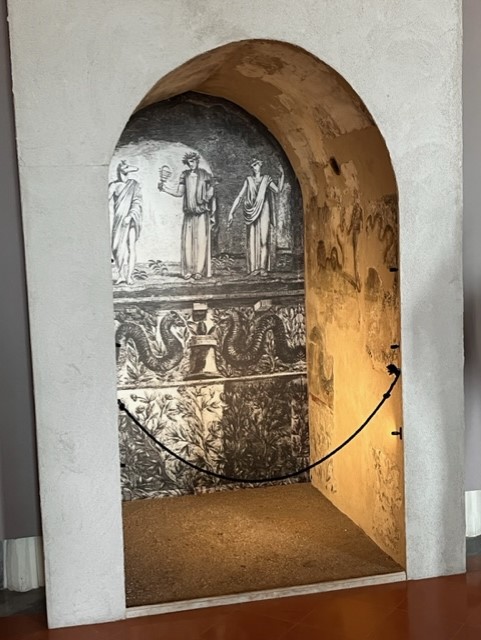
A niche used as a shrine depicting the Egyptian gods was found in the South-Western corner of the garden belonging to a domestic unit within the House of Julia Felix (Praedia Iuliae Felicis) (Pompeii II.4.3).
The House of Julia Felix was a large building on the Via dell’Abbondanza which contained several sub-let properties, including public baths. We do not know who lived in the domestic unit. It is notable however, that the unit contains a small dining room decorated with Nilotic landscape looking out through a colonnade of marble pillars (the only such colonnade known in a domestic setting) on the inner courtyard with a view of a prominently long water feature as well as the shrine. Was this a ‘Nile’? Was the Egyptian theme of water complemented with a shrine?
The building with its intact shrine was discovered in 1755, early on in the centuries-long excavation of the site. Records were taken and copies made of the shrine. The paintings were then removed and placed in the Museum in Naples. At some point in the nineteenth century, they disappeared. The central panel, showing Anubis, Isis and Serapis, is still missing. The two side panels have since been rediscovered in the museum store. The west panel is damaged and the central part of it is no longer visible, while the east panel is in relatively good condition. The museum now displays the surviving panels with an enlarged print-out of an engraving made by Francesco Piranesi, Piranesi’s nephew, in 1802 to offer visitors an idea of what the shrine may have looked like in situ.
There are differences between the engraving and excavation notes. The print shows further two male deities, one on each side wall of the niche but a description of the niche made before it was lost says that the right wall showed a female goddess with two snakes either side of her.
Nevertheless, the items associated with this shrine form one of the most complete surviving ‘lararium’ assemblages in Pompeii. Although many of the items are too damaged to give a secure identification, statuettes of Amor, Harpocrates and Priapus have been identified.
Toilet painting
Another intriguing wall painting, found in the Caupona of Tertius (IX.7.22 Pompeii), depicts a person voiding their bowels. The position is a correct and healthy one for good defection and the painting might be studied with profit.
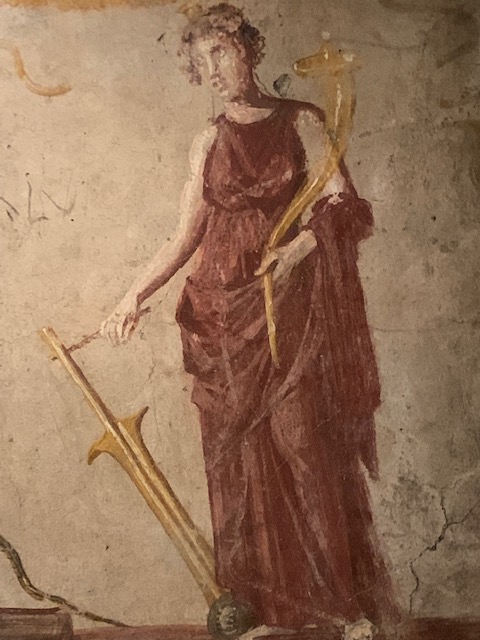
What is of interest to us here however is the presence of the goddess Isis-Fortuna. She carries a rudder in one hand (steering the ship of fate) and a cornucopia in another. On her head a small crown. Fortuna and Isis Fortuna were important goddesses in the working city of Pompeii.
Foo and sanitation were obviously important to fortune and so we should read the presence of the goddess, as protective rather than adding to her many powers, the relief of constipation.
Small objects
Alongside statues which seemed to have served a religious purpose have been found many items, which were likely seen as objets d’art. A set of white alabaster canopic jars were likely prized as beautiful items. They may not have received cult adoration, but they may have been owned by someone with a connection to the Egyptian gods.
Other items are harder to distinguish between luxury good Several small statues of Bes have also been found across the region. Some of these were gorgeous objects. Perhaps they were high end equivalents of the nazur (eye amulet) or lucky horseshoes, but this fits well in the context of Pompeiian domestic religions.

On the other end of the scale, oil lamps with depictions of the goddess have also been found in Pompeii. Several show the group of Isis, Harpocrates and Anubis. This may reflect religious belief, popular taste or just what was on offer for consumers.
We cannot really know what these objects meant to their owners, but they give some sense of the complex world in which they lived.
Summary
The tragedy of Pompeii haunts us still, and with reason. But one of the many lessons it can still teach us is the importance of understanding societies as complex and full of individuals and groups operating on many levels. The presence of Egyptian items in the archaeological records offers us a good way of understanding this process in more detail.
 Rhakotis
