In a school assembly back in 1999, I remember a teacher telling us that some people didn’t believe the new millennium started on 1 January 2000 then only a few weeks away, but on 1 January 2001.
At the time, it sounded like the most pedantic thing I had ever heard. The change of numbers, the ring of zeroes, was the key thing, like some great refresh for humanity, limping from a century of disaster, into what felt like an open future powered by internet chat rooms, brand good capitalism and American (soft) power.
It didn’t turn out like that and with hindsight in many ways 2001 feels much more the keystone of the new century. As I have grown into the millennium, I agree more and more with the second camp seeing the millennium starting on the ’01.
Anyway, given that most people see the millennium as starting on the zero year, that means we’ve nearly completed 25 years of this millennium, a quarter of the century.
This has been a time of geo-political change, of growing environmental concern and reflections of identity which have all impacted the study of ancient history, against a backdrop of the topic being politicised and sidelined.
So what then were the books (about Ancient History and related topics) that defined this period? Here are my suggestions.
2000: The Corrupting Sea by Peregrine Horden and Nicholas Purcell
A paradigm setting book that explained the Mediterranean Sea as a coherent geographical unit defined by connection and difference and shaped by long lasting geographical trends. Building on the work of Fernand Braudel, they argued that the islands, cities and agricultural lands of the region experience micro-climates which result in varied harvests each year, evened out through trade, enabled by the sea.
2001: Emperor’s Babe by Bernardine Evaristo
Zuleika, a feisty young poet in ancient Londinium, falls into a complex relationship with the most powerful man in the world.
2002: If not, winter: Fragments of Sappho by Anne Carson
The ever verdant verse of Sappho sang again with new freshness in the hands of Canadian poet Anne Carson. This has become the go-to-translation, highlighting the fragmentary nature of the corpus. It creates a more emotionally rich yet elusive window into antiquity akin to Emily Dickinson.
2003: Lost Scriptures: Books that Did Not Make It into the New Testament by Bart Ehrmann
A lucid study of a thorny topic, which is often either sensationalised or incredibly dry, this is popular history that nevertheless does some serious scholarship. Ehrmann, a former evangelical Christian, explores the history of the New Testament before it became codified, including the many books that were excluded from the ‘canonical’ list.
2004: Egyptology: The Missing Millennium: Ancient Egypt in Medieval Arabic Writings by Okasha El Daly,
An absolutely vital addition to any library of antiquity. El Daly’s analyses the many accounts of Ancient Egypt in medieval Arabic texts and makes a convincing case that some knowledge of hieroglyphs may have survived to a much later date than often argued based on epigraphy from Philae.
2005: Cold Calls, part of War Music by Christopher Logue
One of the best translations of the Iliad, famously written by someone with no knowledge of ancient Greek. Logue based his visceral poetry on earlier translations into English, but he nails the grim beauty of Homer’s original like no other.
2006: Isis, Dame des Flots by Laurent Bricault
The first version of Laurent Bricault’s important, period-defining study of Isis in her guise as goddess of the seas. The culmination of deep study, Bricault returned to the topic ten years later in a new edition in English, Isis Pelagia.
2007: The Egyptian Renaissance – The Afterlife of Ancient Egypt in Early Modern Italy by Brian Curran
Some of the first books directly translated from ancient Greek into Latin during the ‘Renaissance’ were the magical texts of Hermes Trismegistus. Cosimo de Medici ordered the translator Marsilio Ficino to stop his work on Plato in order to translate them. The translations later became some of the first ancient texts printed in 1471. Just one of the many intriguing facts in this book.
2008: Pompeii: The Life of a Roman Town by Mary Beard
The face of classics for much of the 21st century in Britain, Mary Beard brought important new research into a public arena and championed ancient history as an academic subject. Her book and TV series on Pompeii were perhaps where she first gained widespread public fame, building on her extensive scholarship.
2009: Early Christian Books in Egypt by Roger S. Bagnall
An important papyrologist and scholar of Roman Egypt, Roger Bagnall’s books have built and dismantled several scholarly paradigms. In this short but decisive study he pushed back the date of the book (codex) back several centuries. A niche but important topic.
2010: The Hemlock Cup: Socrates, Athens, and the Search for the Good Life by Bethany Hughes
A readable study of classical Athens by one of the predominant popularisers of ancient history. Engaging, insightful and enjoyable, a good introduction to a massive subject.
2011: A History of the World in 100 Objects by Neil MacGregor
A fresh way to use museum collections in podcasts and then books. It has become hugely influential and copied.
2012: Through the Eye of a Needle by Peter Brown
One of the major works of an important historian, the fruition of a lifetime’s study of late antique Christianity, demonstrating his wide ranging gaze and ability to move from intimate detail to the panoramic wider picture.
2013: Asterix and the Picts
To be fair, I consider Asterix a book of the twentieth century, summing up Les Trente Glorieuses, the post-war years of an expansive consumer market in France. It was also one of my first introductions to ancient history (in the 1990s), but this book, the first created since Goscinny and Uderzo showed there’s life in the old Gauls yet.
2014: Religious Networks in the Roman Empire: The Spread of New Ideas by Anna Collar
The century so far has been the ‘Age of the Network’ with the rise of social media platforms. Conceptualising the spread of anything (trade goods, diseases, new ideas) through the guise of network theory is a powerful way to identify underlying causes, key figures and local clusters. Collar’s work is an important application of this approach to ancient history.
2015: The Silk Roads by Sir Peter Frankopan
A ‘new history’ of the world, as seen from central Asia, published just as China’s expansionist Belt and Road Initiative (BRI) was being developed, promising to re-shift the Global axis. Showing how historical study can make us rethink the contemporary.
2016: Meetings with Remarkable Manuscripts by Christopher Hamel
An enjoyable read that expresses some of the excitement and sheer wildness of engaging with historical sources and the people who curate them.
2017: Strange Heart Beating by Eli Goldstone
A powerful and complex story opens following death by swan. This short novel rewards multiple re-readings.
2018: Ancient Egypt by Christina Riggs
Contextualising the study and cultural influence of Ancient Egypt within contemporary and historical geo-politics, this book is a valuable introduction highlighting various topics for further discovery to learn more and challenge preconceptions.
2019: Nefertiti’s Face by Joyce Tyldesley
In 2024, the Egyptian authorities requested the return of three items: the Rosetta Stone from London, the Dendereh Zodiac from Paris and the Bust of Nefertiti from Berlin. Reading this book, you understand why. An incomparable artwork, taken to Berlin under very shady conditions, the lifelike plaster bust of Nefertiti has been the gem of the Neues Museum since the 1920s. An object lesson in the importance of archaeology.
2020: A People’s History of Classics by Edith Hall and Henry Stead
A comprehensive study of working class engagement with classical antiquity from 1689 – 1939, full of interesting vignettes, some inspiring, some funny and some sad about the self-taught classicists “who retained a preference for a lifestyle too coarse to allow them to qualify as gentlemen”.
2021: The Werewolf in the Ancient World by Daniel Ogden
What appears at first glance to be a fun piece of popular history, opens up into a multi-faceted and scholarly exploration of a subject with lots of different pieces of evidence. Ogden handles his topic well, creating an engrossing book that is genuinely eye opening.
2022: Isis in a Global Empire by Lindsay Mazurek
The spread and worship of the goddess Isis and her fellow Egyptian gods is perhaps the single most important aspect of the ancient world. This book explores what it meant to be a follower of the goddess in Greece, especially during the Roman period, touching on wider topics like ethnicity and cultural identity.
2023: Queens of a Fallen World by Kate Cooper
A deeply engaged and imaginative study of four women in Augustine’s Confessions, whose stories are obscured by the Saint.
2024: Messalina by Honor Cargill-Martin
A fascinating study of the Roman Empress, one of the best of several excellent books published in recent years highlighting the lives of ancient women.
So, what were your favorite books?
What did you think of the last 25 years?
What do you think are the topics, themes and subjects that will matter in the next 25?
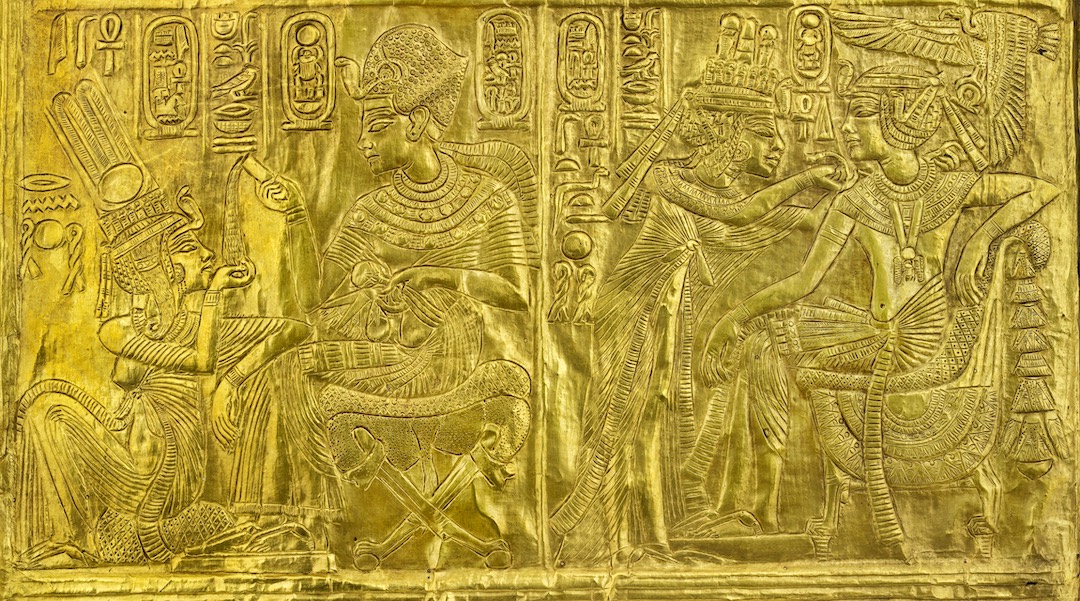
(Cover photo from Tomb of Tutankhamun)
 Rhakotis
