Perhaps it’s a sign of the times: great uncertainty and fear, uncontrollable powers emerging, a sense of the times changing over, but the occult and mythic has enjoyed a particular vogue this year with a major exhibitions in London and Oxford on tarot and oracles and a fantastic installation by Renee So at Compton Verney.
Tarot at the Warburg Gallery
Tarot, which has become ever more popular in recent years, was celebrated at a stellar show in the Warburg Gallery.
Tarot cards go back to the earliest days of card making in Renaissance Italy.
Playing cards originated in China, reaching Italy via Persia and then Egypt.
The cards used in cartomancy, were originally playing cards (and are still used for games in some regions like France).
In 1781, Antoine Court de Gebelin, a French Protestant pastor and Freemason, argued the cards had an esoteric significance.
He linked them to Hermeticism, a belief in arcane knowledge passed down the generations from Hermes Trismegustus, a Hellenistic form of Thoth, the ancient Egyptian scribal god.
Hermeticism survived antiquity and in Western thought, Egypt was long associated with the occult, secret knowledge as a result.
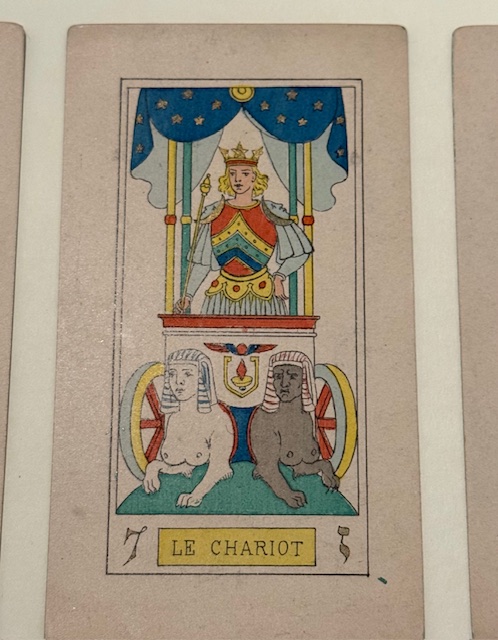
In 1783-5, Jean Baptiste Alliette (known as Etteilla) published a guide to tarot and in 1789 published his own deck. Etteilla developed, standardised and popularised tarot, firmly establishing the Hermetic understanding.
For the curators of the Warburg exhibition, this was the crucial moment: ‘The historical rupture when tarot “became Egyptian”.
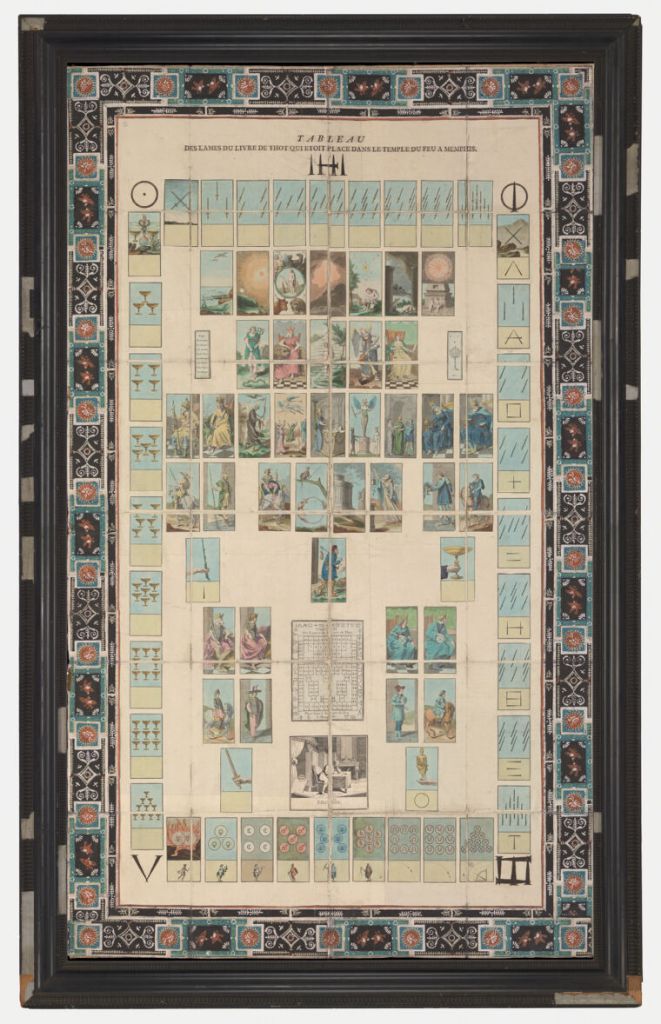
In the 19th century, use of the cards expanded due to industrial production.
When the tarot was introduced to Victorian Britain, the impact was powerful, not least because no one had seen such cards.
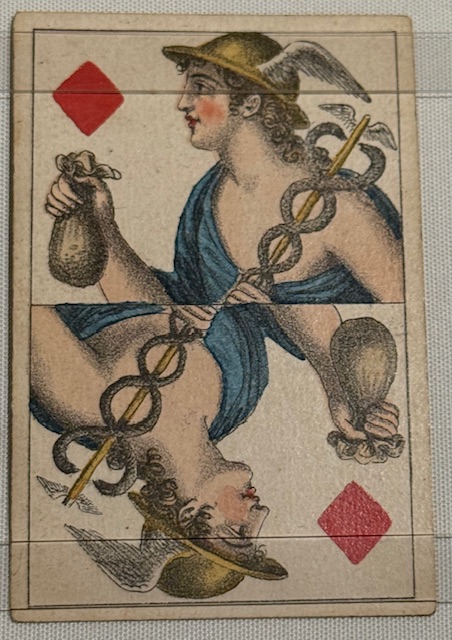
Britain uses the French suit of cards (diamonds, hearts, clubs and spades) for playing cards, not the Latin suit (clubs, swords, cups and coins) used in tarot decks.
In addition, the deck includes a 21 trump deck (the major arcana) not found in the playing cards used in Britain.
This made the cards feel even more strange to a British audience and added to their occult allure.
The Hermetic Order of the Golden Dawn, a ceremonial magic organisation with an interest in Egyptian magic, are behind two of the most important decks of the Twentieth Century.
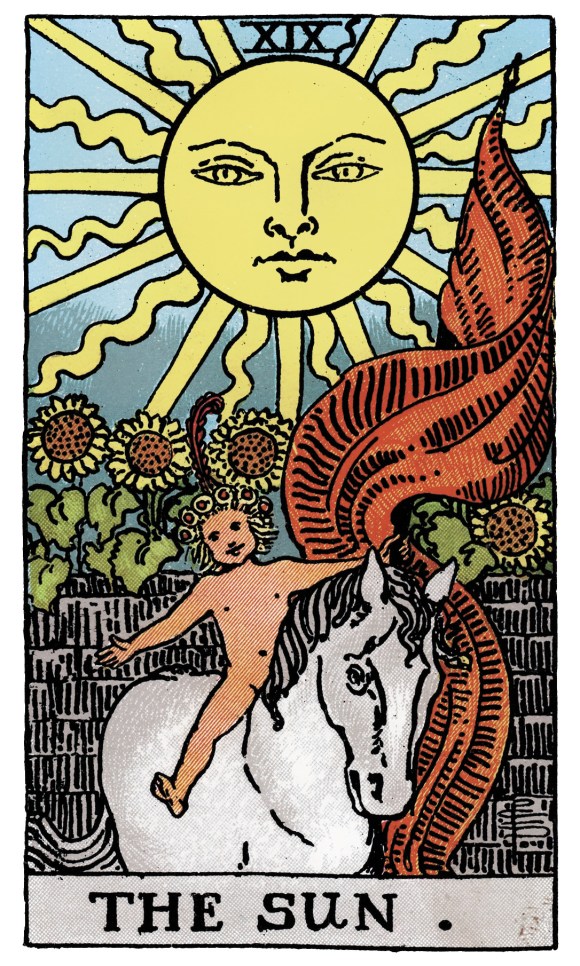
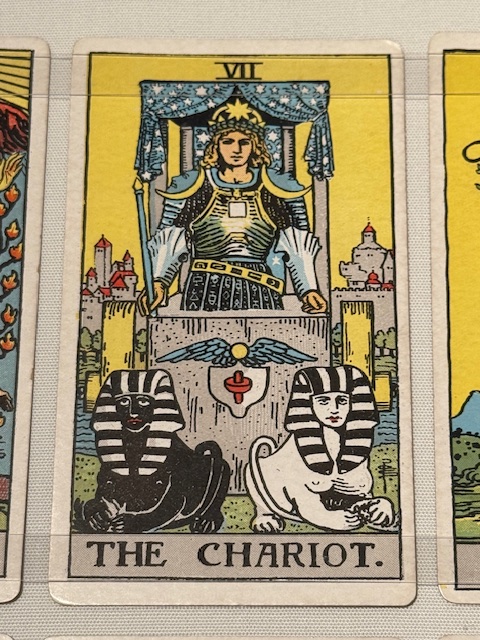
The now synonymous tarot deck, the Rider-Waite-Smith tarot was co-designed by the artist Pamela Colman Smith and the occult scholar Arthur Edward Waite, a co-founder of the Hermetic Order of the Golden Dawn. (William Rider was the publisher.)
Smith was a London based bohemian artist, who had been written out of the history of Tarot, but is recognised as an important figure in her own right.
She is celebrated in an excellent graphic biography Queen of Wands by Cat Willett and is the subject of a charming chapter in Arthur Ransome’s memoir Bohemia in London.
Her deck combines more clearly occult symbolism with bright colours and joyful faces.
The image for the sun card, depicts a young man riding a pale horse with a massive smile on his face.
The flowery wreath and symbol feather recall Hellenistic depictions of Greek and Egyptian gods.
The sun is a little more stolid, but one notes a certain sardonic glint.
The horse is perhaps less happy.
Although simply drawn, these cards encourage close study and reflection.
Aleister Crowley collaborated with Lady Frieda Harris on a set of cards, the Thoth pack.
Due to wartime constraints, they communicated via letters to perfect the designs.
Crowley was long interested in Egyptian motifs.
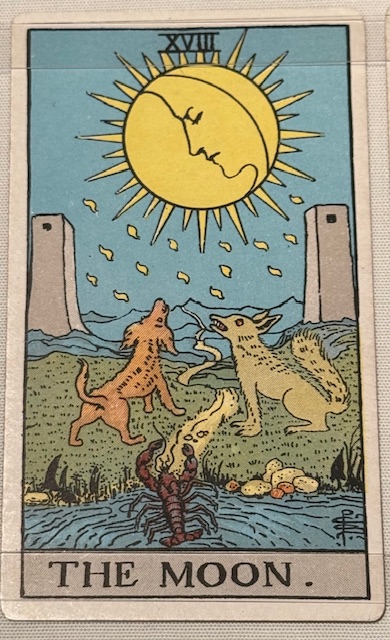
A design for the Moon card, now in Palermo, painted in the early 1920s during his ill-fated attempt to set up a religious commune of Sicily, shows two jackals. One pale and one dark. Earlier packs had shown two dogs with tongues, licking the lunar beams.
The cards of the Thoth pack have a stately design: classical inspired statues, set against abstract, almost nuclear backgrounds, visually articulating a new reality.
The Fortune card depicts the wagon wheel, a monkey-like creature is climbing and a crocodilian-anguipede is falling but on top in gentle repose, sits a stately Egyptian sphinx.
The Adjustment card shows an art-deco like Osirian figure holding a sword.
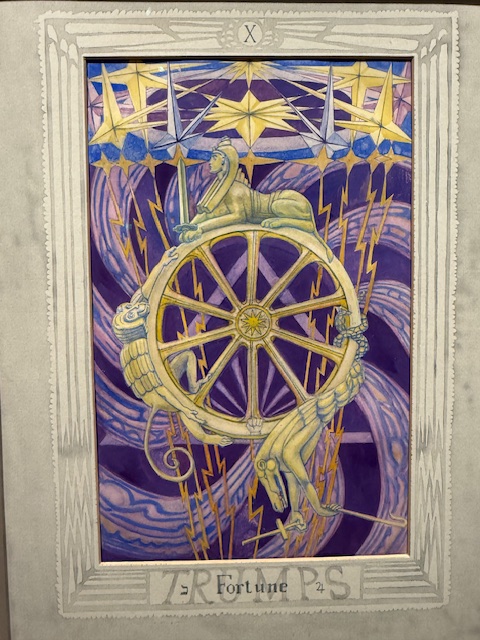

So even if ancient Egypt’s role in the history of the cards was a fabrication, Egyptian art and mythology nevertheless had a profound and deep impact on modern artists and practitioners.
Alongside the historical interest, the show highlighted the artistic beauty of the cards.
If you missed the show, then Tarot and Divination Cards: A Visual Archive by Laetitia Barbier is a good introduction.
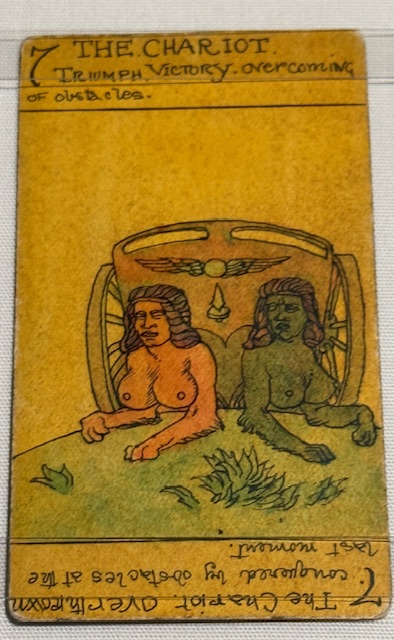
Divination: Oracles and Omens at the Bodleian Library
Acting almost as a sister exhibition to the Warburg, Divination: Oracles and Omens in Oxford used the Bodleian Library’s collections to explore divination across from different societies and periods.
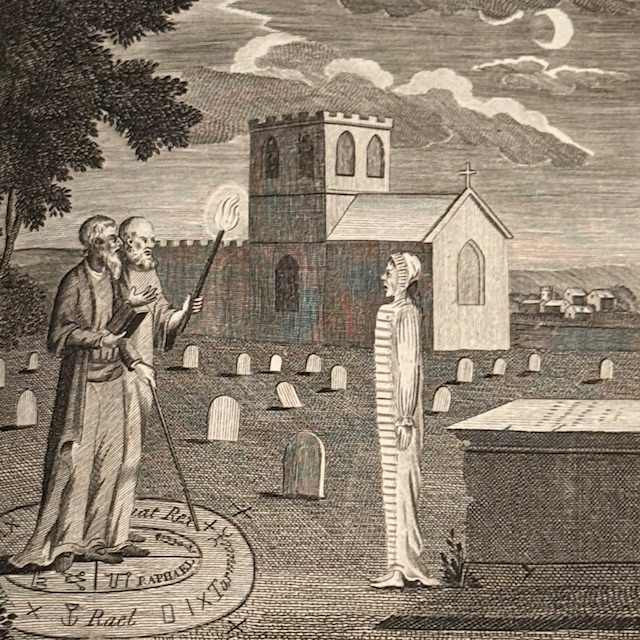
It was full of interesting little stories. Nancy Reagan spoke to her astrologer Joan Quigley daily and advised Ronald regularly based on readings. While Elizabeth I’s magician John Dee woke the dead in Mortlake (see cover image).
As always, animals played a part in human’s understanding the beyond them ness.
Highlights included the medieval sortes which used bat, bird or butterfly judges to help people understand future events. While a large digital installation explored spider divination in Cameroon. This is perhaps the most scientific of all such practices with diviners testing their spiders with questions such as ‘Will I drink beer tonight?”
A fascinating exhibition.
Commodities: Sculptures and Ceramics by Renee So at Compton Verney
“It’s cracking”, a member of the gallery’s curatorial staff told us as we entered the installation space, taken over by Hong Kong born ceramics artist Renee So.
Renee’s art is large, colourful, fun, thoughtful, deeply researched and technically perfect.
In her installation, she has been inspired by the Chinese bronzes and ceramics collected by Peter Moores and displayed at the Warwickshire stately home he turned into an art gallery.
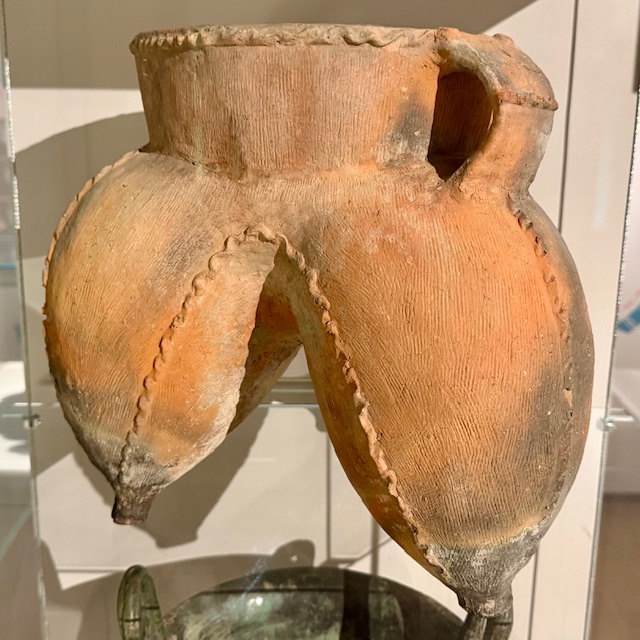
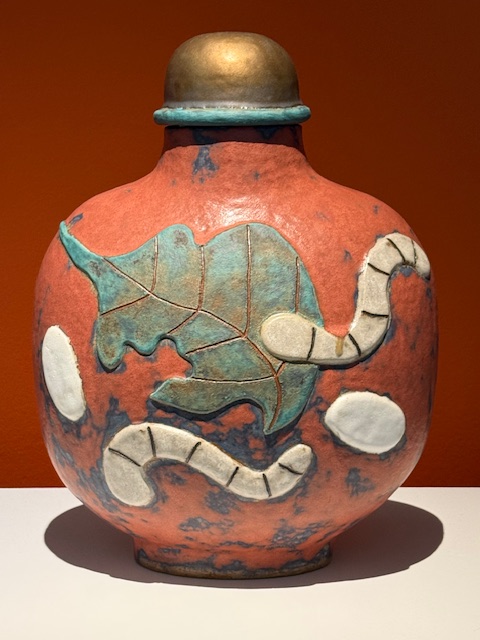
In particular, Renee has drawn on the Taotie, a mythic beast that may have originally developed from silk worms, the small animal central to international trade and economic power in the ancient and medieval world. She uses it as the basis to explore contemporary politics, economics, sex and art.
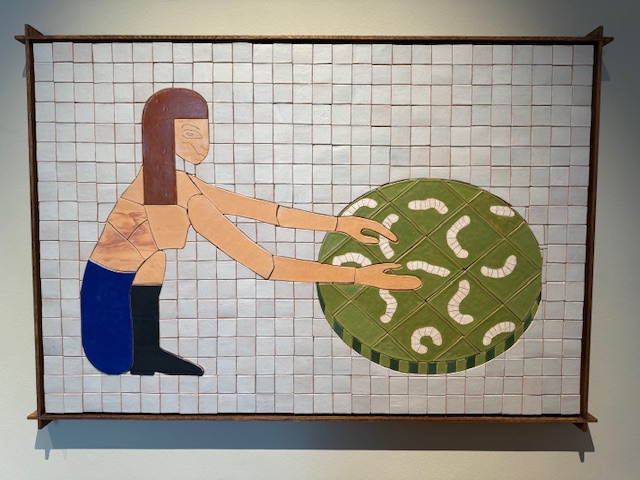
In Sericulture a woman tends to oversized silk worms feasting on mulberry leaves. It also recalls ancient Egyptian tomb art.
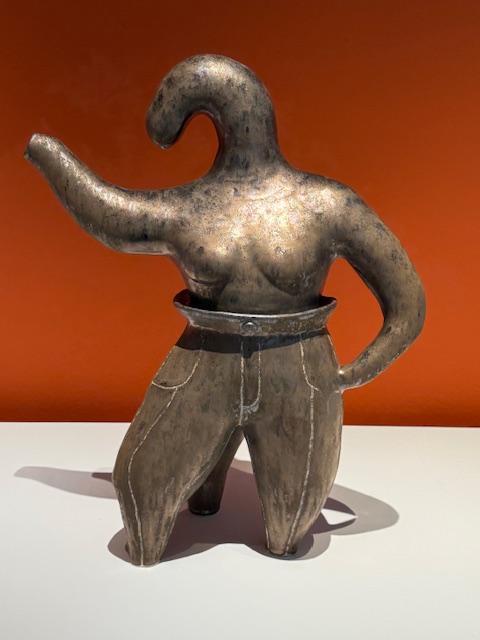
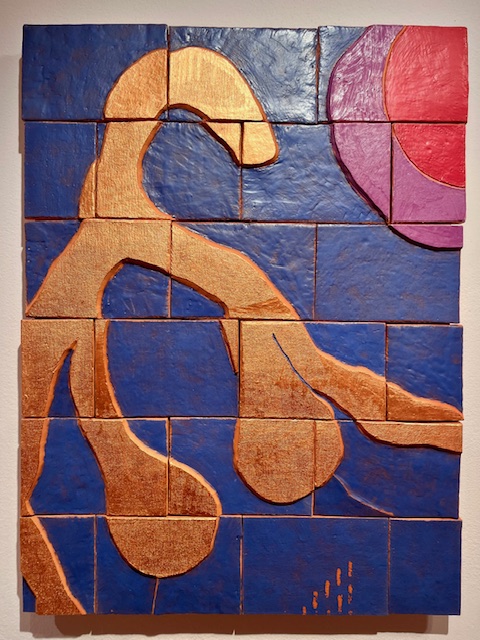
In her glazed stoneware work, she explores the figure in different poses. The figure recalls the clitoris. “It’s a symbol of the female”, she writes. “It’s a source of pleasure; it has no other function. It’s hidden, most of the organ is internal with only a tiny bit external. It’s still a mystery to men, and it was only fully studied for the first time in 1998. It has a great shape reminiscent of many ancient objects – Egyptian goddess artifacts, Chinese garlic-head and Chinese goose-headed vessels.”
Earlier this year, Renee also showed at Self-Made: Reshaping Identities at the Foundling Museum alongside Rachel Kneebone, Matt Smith and Phoebe Collings-James.
This was the first showing of her important new work Enjoy Life More (2024), created from 21 glazed earthenware tiles, depicting a shape in gold against a blue background, combining the iconography of ancient Egyptian goddesses and the anatomy of the clitoris.
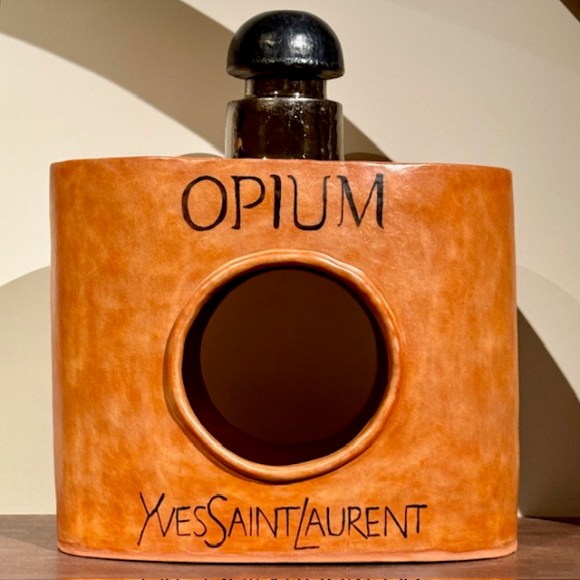
Alongside her new work at Compton Verney, Renee also displayed previous art including her oversized perfume bottles, a series she began in 2019 inspired by the history of Hong Kong.
The bottle of Yves Saint Laurent’s Opium scent is even more topical in this space.
“I was aware of this perfume because my mum wore it in the 1980’s, the bottle looked so sophisticated and glamorous on her dressing table, she even wore it as a necklace around her neck. As a kid, I had no idea what opium was, I just thought the perfume was cool. Only as an adult did I connect the perfume with the Opium Wars and the British colonisation of Hong Kong.”
Not only do the names and tastes of the bottle recall earlier forms of colonialism, but the designs of the bottle recall Chinese snuff bottles.
Snuff (tobacco), silk and other luxury items are the goods traded on international networks.
Renee So flattens the distance to experiencing history in a tangible way and forces us to question our role in the present.
I do not know of any other artist today, working at this level of visual and intellectual excellence.
Other notable exhibitions in 2025
Unless otherwise stated in the caption, all photos of artworks in this article were taken by the author and are used under fair use as part of a review.

 Rhakotis
