
Making Egypt, V&A’s Museum of Childhood (until 2 November 2025)
Come away with me
The gods Ptah, Atum and Thoth are our trusted guides through the long history of Egypt at the V&A’s Bethnal Green Branch.
Everyone loves the Egyptian gods.
How strange then that one of the first pieces of text says the Egyptians “made myths and created gods to make sense of the natural world they lived in”. This is a playful interpretation, introducing young people not just to the culture that grew out of the rich silty soil of the Nile Valley, but also to deep philosophy.
The gods are the made-makers, the copy without an original, the simulacrum of post-modernist French theory. Yikes.

This is a gorgeous exhibition, spaced out items with captions placed at child height, dramatic stage settings and bright colours.
It provides a good introduction to a complex civilization for kids of all ages. Art objects predominate with statues of gods, engravings and wall paintings, but the curators examine the making of these objects.
In one vitrine, the chisel and mallet of engravers highlight the sheer physical effort of learned writing. While a large block of stretched canvas with do not climb signs represents the size of the limestone blocks which make up the pyramids at Giza.
This handily demonstrates the ingenuity of hauling these massive stones with such mathematical precision, but they missed a trick.
The exhibition covers both original items and ‘reception’, items inspired by Pharaonic cultures, including fashion, comics and toys. An interesting element of this is that contemporary Egyptian artists and makers were featured.
A particular highlight was an applique panel made 100 years ago by an unknown Egyptian maker. It still pops with colour and kinetic energy. The museum caption has to have a warning ‘This is not ancient Egyptian!’ High praise indeed.

Khayamiya is an Egyptian textile artform that dates back to the pharaonic period and is still practised today. The item was made for tourists and is an impressive artwork.

The majority of ancient items on display came from UK museums, often collected during the Victorian period.
One caption asked the question:
Why are there Egyptian objects in London?
Today, when objects are excavated in Egypt, they must stay there. But in the past, archaeologists from all around the world took the things they dug up.
Even objects from the same tomb (like the shabtis behind you) were sometimes split between different museums, scattering them worldwide.
It seems a shame they could not discuss the colonial background to this acquisition during the nineteenth century. Adults find this challenging, but kids have more flexible minds and perhaps can better understand the tension between wrong and (supposed) right. How else to reflect on the high-minded mixture of imperialist brutality and scientific study that met in Egypt, most notoriously in 1888 when British forces bombarded Alexandria. An act of violence that consolidated control over the country and further enabled European research and acquisition of Egyptian antiquities.
The show’s popularity will be in part thanks to the subject’s presence in the National Curriculum. At some point the British Empire will become an important part of our nation’s education.
In the meantime, there is an ethical duty on museums to highlight this background and how it continues to permeate our understanding of topics, like ancient Egypt, that at first glance may seem unconnected.
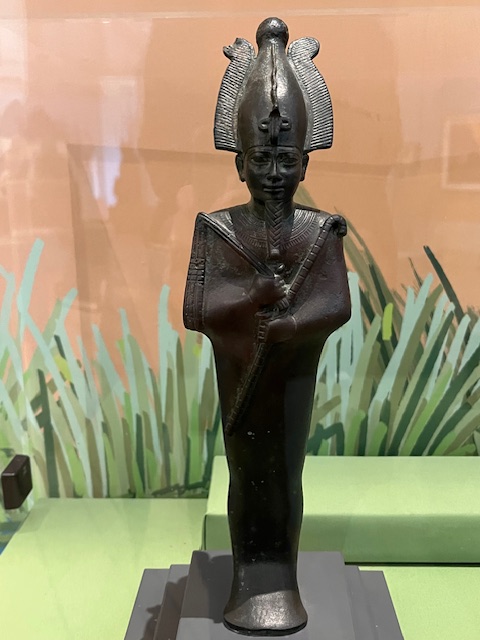
This is a stunning show and highly recommended.
But at £9 a ticket for children over 4, the price can exclude many people. Museums are operating under severe financial constraints, but these objects should be made accessible to as many people as possible.
If they are not, essentially the museum is operating as a form of extra tutorial, laudable work but also fast tracking the kids of richer parents and ultimately perpetuating inequalities.
Tutankhamun Experience
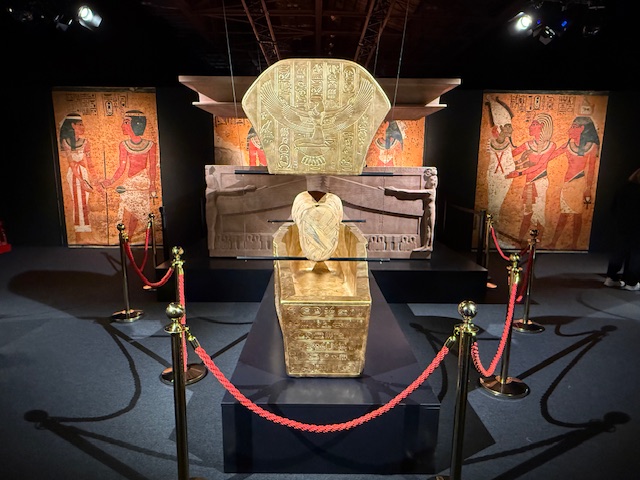
And so, we move onto Immerse LDN’s Tutankhamun Experience at the Excel Centre, next door to their wildly popular Friend’s Experience.

It is designed as a fun day out and nothing wrong with that.
On the plus-side, this is a well thought out show which seems to pre-empt much of the way museums will go in the twentieth first century with a combination of immersive technology and replicas.
The tech on offer is stunning: immersive light shows, holograms, two VR headsets. But it’s let down by some poor audience experience (UX). Long queues in dark and congested spaces are perhaps meant to evoke the experience of tomb digging, but quickly tire.
I have long argued, with many others, that replicas should be used in British museums (with the permission of source nations) and requested items returned where the provenance is questionable.
But the replicas here looked so much like plastic toys, I had assumed they would be on sale in the gift shop. They were not, which was ironic given that the original objects were donated by Galería F. Cervera, which I later found out is a commercial gallery. The Duamutef Canopic Jar on display is actually on sale on their website (Price on Request).
The exhibition is educational and teaches kids of all ages about both ancient Egypt and the modern study of the subject in an accessible and fun way.
If I was down on the V&A for questionable interpretation though, I nearly had a heart attack here.
One of the first pieces of text says:
The true blossoming of Egyptomania came in 1798 with Napoleon’s expedition to Egypt. Never was a defeat so victorious. Even though the French were beaten by the Royal Navy, led by Lord Nelson, the military failure was superseded by the success of the scientific expedition that travelled with the French soldiers. This expedition materialised in the first third of the 19th century in the famous Description de l’Égypte, a collection of almost forty volumes which, for the first time, displayed the scientific knowledge of Ancient Egypt to the public through plans and illustrations.
As Generative AI gets better, it is almost laudable to see a paragraph that combines inaccurate and confusing language and questionable interpretation.
I would have liked more about the Egyptian archaeologists working with Howard Carter.
Ultimately, the team’s focus was on the impressive entertainment but it was let down by small details like this.
It can be a very expensive trip, nearly three times the amount of the V&A exhibition for a family of two adults and two kids.
Much better to visit one of London’s free museums, I think.

 Rhakotis