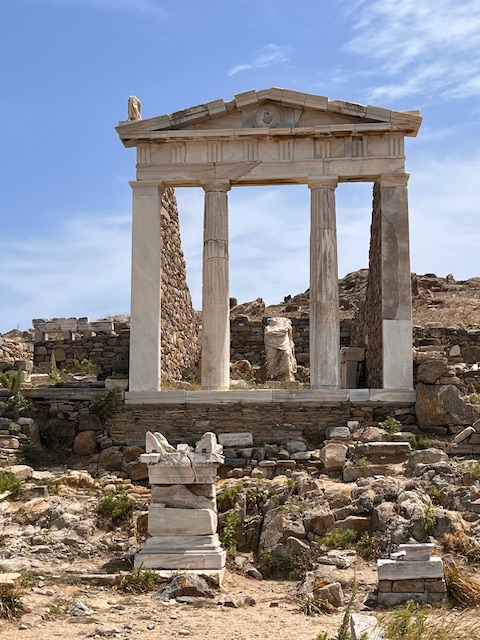
To understand the contemporary world, one must understand antiquity and to understand antiquity in all its complexity one must fully comprehend the spread and role of the goddess Isis across the ancient Mediterranean.
In her new book, Egyptian Cults and Sanctuaries on Delos, Helene Brun-Kyriakidis offers the most current archaeological research on this important topic in an easy to read format. She is an expert on the topic and as a member of the French School in Athens, who were the first professional archaeologists to excavate on the island in the late nineteenth century, she has easy access to the sites and excavation records.
The importance of Delos
Delos is important for two reasons.
First it offers archaeologists rich information. The island was sacked in 88 BCE and 69 BCE. Although inhabited after this date, it was no longer an important trading point and the number of people dropped significantly. As a result, old buildings were not reused for building but instead left to gracefully age in the Aegean sea and wind. The island contains a lot of inscriptions which provide important information of the cults including financial records and the names of different religious offices from which historians can glean information for the uptake and administration of the temples and the rituals and activities that took place. Roles such as basket holders, lamp bearers and names of religious associations hint at a busy calendar of religious processions and celebrations. There is also tantalizing evidence that some form of incubation may have taken place and oracular advice given.

Second, our evidence shows that Delos was important for the spread of the cult.
The island of Delos can claim to have a central role in world history as one of the most important centers for the spread of the goddess and her cult. It was an important stopping point for maritime trade leaving Egypt for the cities of what are today Turkey, Greece, Italy and beyond.
These interconnecting trade routes are sometimes called a network. This model identifies the ports where there was a lot of trade between different places acting as hubs: places of substantial and multiple exchange on the one hand, but also places of centrality, in a decentralized international community. Reading ancient trade as a network comparable to highway routes or internet connections belies the more jolting experience of sailing. The Mediterranean is a peaceful sea, but even today, in modern ships, sailing into Delos from nearby Mykonos can be a hair-raising experience.
It is also important to reflect on what was actually traded. Ships carrying both grain from Egypt in the South and Ukraine in the North likely came to Delos before proceeding elsewhere. Yet, according to the Roman geographer Strabo, its most important trade was in enslaved humans. He claims 10,000 humans were sold a day. These numbers may stretch credibility given the layout of the port and its facilities, but his testimony reveals the brutality that is often obscured by the neutral word ‘trade’.
A network reading provides a useful way to understand why Delos became so important.
Delos had made its name first from the presence of an important cult center to the god Apollo, said to have been born on the island. The palm tree against which his mother, Leto, squatted while giving birth to him was still (said to be) visible in antiquity. As the temple’s regional importance grew, Delos became an important financial and political center. It was twice administered by Athens, most famously becoming the location of the treasury of the Delian League, the allies or dependencies of the Athenians, to which the island lent its name, even after the treasury had moved to Athens.
In 166 BCE, the Romans made the island a free port (administered by Athens). Trade and immigration boomed. From around this time, foreign gods become more present in the archaeological record.
There are similarities between the Egyptian cults at Delos and elsewhere, most significantly in Pompeii. The great Isis expert, Michel Malaise argued that the presence of the god Anubis in Campania proves the importance of Delos in the spread of the cult. Campania was the location of the first temple to the Egyptian gods on Italian soil (that we know about). From the port of Putelio, it spread overland to Rome where it became wildly popular. That is a topic but another day, but without Delos this would not have happened, or at least in the way that it did.
The Egyptian gods arrive
The introduction of the Egyptian gods on Delos forms one of the most intriguing tales surviving from antiquity.
An inscription was set up in one of the three temples dedicated to the Egyptian gods (called by archaeologists ‘Serapeum A’). Apollodorus records how his grandfather, from the priestly class in Memphis, brought the god Serapis to Delos, initially setting up a small shrine in his house. Later, the temple was moved to its own building.
The god, an avid real estate agent, suggested a prime piece of land in a place currently covered in dung.
Later, the temple was taken to court but the accusers were struck silent by the god and the temple won the case. There is a lot going on in this inscription, but it suggests that the people who frequented this particular temple were proud of its Egyptian origins.
This inscription dates the introduction of Serapis to the start of the third century BCE and the building of the first Serapis Temple (or Serapeum) to the end of the third century and the start of the second century BCE.
The so called Serapeum B, included small altars and benches. Less is known about this temple. The inscriptions all come from groups of followers, so it may have been a private members club.

The gods go up in the world
A much grander temple was built further up the sides of the small mountain which rises above the island.
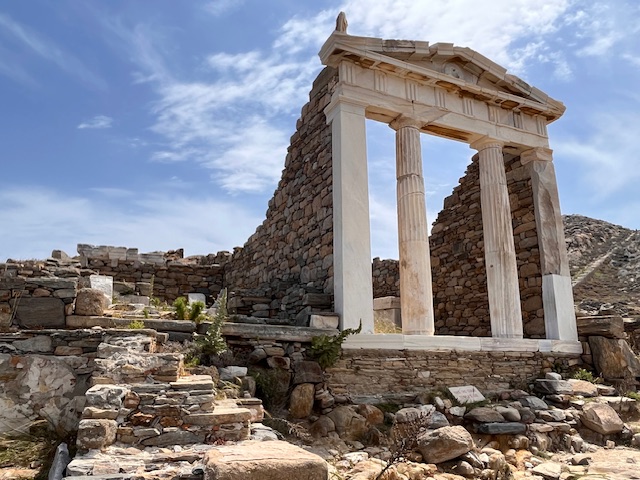
This is the Serapeum C, which grew over several decades, becoming by 90 BCE the second richest and second most important temple on the island. Three small temples within the wider temple complex were dedicated to the gods Serapis, Isis and Anubis. Recent research suggests the presence of a small temple to the deified water of the River Nile.
The partially restored Isis Temple in Serapeum C soars above the island and can be seen from across the sea, lit brilliant white against the olive dun vegetation of Mount Cynthos. Yet in antiquity, this temple, sometimes called by archaeologists a chapel (in the sense of a smaller room in a cathedral) would have been hidden behind the impressive walls of the whole ‘Serapeum C’ complex. A visitor today enters the Serapeum C by the wrong entrance and may not realize just how big it actually was. The main part of this complex is currently out of bounds to visitors. In antiquity, this may have been the part of the temple complex that most visitors saw, possibly forming an important congregational area. It was a later addition to the complex, showing that there was a level of increasing investment and importance in the cult.
The first buildings dedicated to the Egyptian gods on this site may date to the later second century, with later additions dated to 130 BCE.

Domestic religion in Delos
The presence of three religious sites on the small island demonstrates a strength of feeling towards the Egyptian gods. The evidence for the cults in domestic or personal settings is not as rich, but still provides useful evidence. Terracotta figurines, jewelry, lamps and reliefs all survive.
An intriguing difference between the temple and domestic settings is the difference in the relative importance of Anubis and Harpocrates. Anubis is a vital third member of the triad in temples, followed by Harpocrates but never replaced. Based on the evidence that has survived, he is absent from the domestic settings.
Harpocrates, a later addition to the ‘Delian Triad’ in the temples, was popular in some houses. Several terracotta statuettes of him have been found on the island. These were relatively cheap and may have been used as the focus for some kind of domestic cult or may just have been thought ‘cute’. Indeed, some beautiful gold earrings have survived, which depict the god with his archetypal gesture of finger in his mouth. These may have signposted the wearer as an adherent of the god, but were not cult objects.
Why one god was popular in the temple and one in people’s homes and vice versa is not clear.
I don’t think it’s just that one was the god of death (suitable for a solemn temple, but not a home) and one the god of new life, abundance and joy. In the cemetery on the nearby island of Rheneia (internment was not allowed on Delos), several graves contained items connected to the god such as bronze sistrums, or rattles, originally associated with Hathor and later with Isis. Yet, no items connected to Anubis have been found yet.
There is still a lot to discover on this beautiful island.
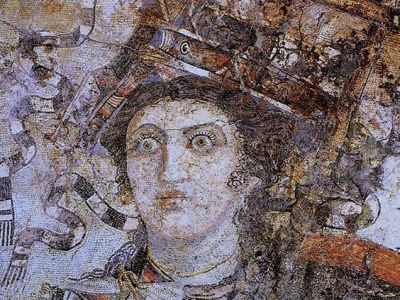
Isis, goddess of the seas and the Navigium Isidis
Celebrate the beginning of the maritime season with Isis

An important service that the book performs is to present the archaeological remains of the three temples in clear line drawings. It can be quite hard for a visitor to the island to even see the temples as they are now, let alone visualize them as they were in their heyday.
Looking down from Serapeum C, you see a mass of archaeological remains, among which only the practiced eye of an expert can pick out the other two Serepea.
With simplification, comes a loss of detail. The reasons for the presence of three serapea is still unclear. Some historians see the Serapeum C as public and Serapea A and B as private. The simplicity of these words hide a high degree of uncertainty in both our understanding of the religious cults and the variety of different practices and administration taking place in antiquity.
Brun-Kyriakidis uses the word ‘clubhouse’ for Serapeum B, which makes me think of the Simpsons episode where Bart turned his tree house into a Playboy club, but this may just be me.

So much remains unknown, yet Delos offers an important and interesting field for further research.
Returning to Brun-Kyriakidis’ book, there is something refreshingly French about a book that combines scholarly rigiour and accessibility. Although aimed at the general reader, this is an important addition to scholarship in this area. It is a short book and I recommend it to everyone seeking to understand not just the cult of Isis, but the ancient world in all its complexity and beauty.

 Rhakotis