Apuleius’ Golden Ass, is one of the masterpieces of the ancient world. Even more than Homer or Vergil, it reveals a society in all its gaudiness: full of violence, control, sex, smells, superstition, pettiness and great hope.
The novel follows the adventures of Lucius, a young man, who is turned into a donkey while attempting to learn magic. Before he can be transformed back into a man, he is stolen by brigands. Thus follows a series of adventures (including some stories he overhears), before he is transformed back at the intervention of the goddess Isis.
The narrative is told in the form of episodes, with an overarching narrative. It is a strange book, but perhaps the closest we have to modern fiction from antiquity. It is often rightly called a novel.
It is strange then that it has not led to adaptations into other forms such as films, but there are two comic books.
Les Sorcières de Thessalie (The Witches of Thessaly) by Georges Pichard
The first from 1985 by Georges Pichard takes the bawdy and episodic elements of the novel. Pichard specialized in erotic comics. He made his name in the late sixties with Jacques Lob on the character Blanche Epiphanie, who among other things went to Vietnam. In his later years he adapted erotic classics like the Exploits of the Young Don Juan written by Appollionaire and the Kama Sutra, as well as classics like Germinal by Emile Zola.
Les Sorcières de Thessalie begins just before the start of the Golden Ass and ends just towards the second book.
There is not a single page without nudity. Essentially, it is a pornographic comic (which I did not fully appreciate when I started to read it). Society’s acceptance of porn has transformed since the book was published nearly 40 years ago. There are some scenes which would have been shocking in their day and more so now. The female characters have a certain degree of agency, but not always. Sex here is dangerous and coercive.
Pichard combines the classic look of French bandes desinees (the claire ligne and blocks of color) but he adds specks for detail and uses more muted colors which creates a grittiness. What else to say about the art? He clearly had a type: big breasted ladies with thick eye shadow. I have the suspicion he was also a fan of Abba.
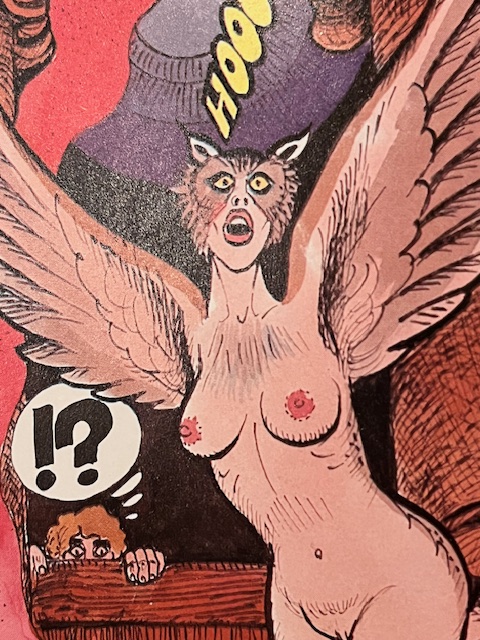

Le metamorfosi o l’asino d’oro (The Golden Ass) by Milo Manara
Milo Manara’s work more closely follows the novel. It begins in a similar way to Pichard’s with a traveler approaching a city. Like Pichard, this is a pornographic work, but somehow both more tasteful and more shocking. Manara worked on various publications, including Heavy Metal. His most famous work, Il Gioco (or Click), tells the tale of a woman implanted with a device to make her become sexually insatiable.
Wikipedia (we all use it) claims Manara’s reputation is based on ‘comics that revolve around elegant, beautiful women caught up in unlikely and fantastical erotic scenarios’. Yes. I can confirm this is the case in his graphic novel retelling. The less said about that scene, the better.
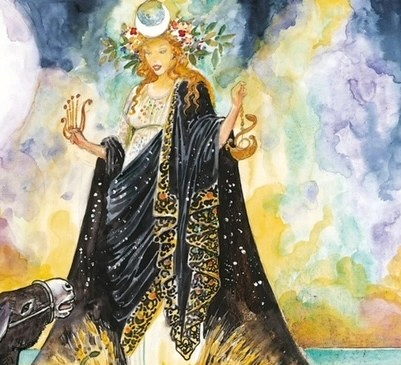
The artwork is stunning. In most frames he uses highly effective line drawings and one or two colors to create realistic portraits. In other frames, the color is freer for added impact. The apparition of the goddess (not explicitly identified as Isis) is depicted with limpid water colors. Manara seems more influenced by cinema than Pichard, in particular Fellini’s Satyricon. A woman, perhaps a sex worker, sits outside a building, her face plastered in white. A multi-leveled room of slaves resembles urban scenes from that film. The body types are also more varied than Pichard’s work.

Summary
Both graphic novels use Apuleius as a source text for sexual exploits, but lose something of his sweeter and more philosophical side.
In the novel, Lucius claims to be a descendent of Plutarch and Sextus of Chaeronea. As I have detailed elsewhere, the final book deals completely with the mysteries of the goddess Isis. While the book’s most famous section is the myth of Cupid and Psyche. This is all missing.
Neither graphic novel features Isis, but it is interesting that both feature a scene in the stables with a small statue of a horse goddess: the Celtic Epona in The Witches of Thessaly and Hippone in The Golden Ass.


I would recommend reading these books, especially Manara’s which has an English translation, but be warned this is strong stuff.
Even better, why not re-read the original work. A feast, in which at every bite, all tastes are satisfied and satiated.
All images are used under the Fair Use license as part of a review. I will remove these artworks as requested.

 Rhakotis